
Your dying loved one does not need an ICU bed but the hospital is billing you ₹30,000 a day anyway. Across Delhi’s private hospitals, a disturbing pattern has emerged: terminally ill patients with no realistic chance of recovery are routinely admitted to intensive care units, kept on ventilators, and subjected to aggressive procedures not because it helps them, but because it generates revenue. This article exposes how it works, what the law says, and exactly what you can do to protect your family.
- What Is an Unnecessary ICU Admission?
- How Private Hospitals Exploit Terminally Ill Patients
- Real Cases and Documented Evidence
- The Financial Devastation on Families
- What Indian Law and Government Guidelines Say
- Red Flags: Signs Your Loved One Is Being Exploited
- Your Rights as a Patient or Family Member
- How to Fight Back: Step-by-Step Action Plan
- The Humane Alternative: Palliative Care in Delhi
- Frequently Asked Questions
- Key Takeaways
What Is an Unnecessary ICU Admission?
An ICU is designed for patients who have a realistic chance of recovering with intensive monitoring and organ support. It is not a warehouse for the dying.
India’s Union Health Ministry made this explicit in its landmark ICU admission guidelines, compiled by 24 critical care experts and released in January 2024. The guidelines define futile ICU care as any intensive treatment that cannot meaningfully improve a patient’s outcome especially survival.
Who Should NOT Be in an ICU Per Government Guidelines (2024)
- Terminally ill patients where continued therapy will not affect outcome
- Patients or next-of-kin who have refused ICU admission in writing
- Patients with a living will or advance directive against intensive care
- Patients with a documented treatment limitation plan
- Any disease where medical judgment has deemed further ICU care futile
Source: Union Health Ministry ICU Admission Guidelines, January 2024
A “terminally ill” patient is one suffering from an incurable, progressive disease advanced cancer, end-stage organ failure, irreversible neurological damage where death is an expected outcome within weeks or months, regardless of treatment. Admitting such a patient to an ICU does not extend meaningful life. It extends suffering, isolation, and the hospital bill.
Yet this happens every single day in Delhi’s private hospitals and families often have no idea it is happening to them.
How Private Hospitals Exploit Terminally Ill Patients
The pattern is not accidental. It is a business model. Here is how it typically unfolds.
1. The “We Need to Stabilise Him” Admission
A patient arrives at a private hospital in advanced illness stage-four cancer, end-stage heart failure, or multi-organ failure. The family is distressed. Doctors use urgent, clinical language to secure consent for ICU admission. The family, terrified of losing their loved one, agrees immediately.
What is rarely explained: the ICU may offer no clinical benefit to a patient at this stage. The intervention prolongs the dying process not the living one.
2. The Revenue Machine Starts Running
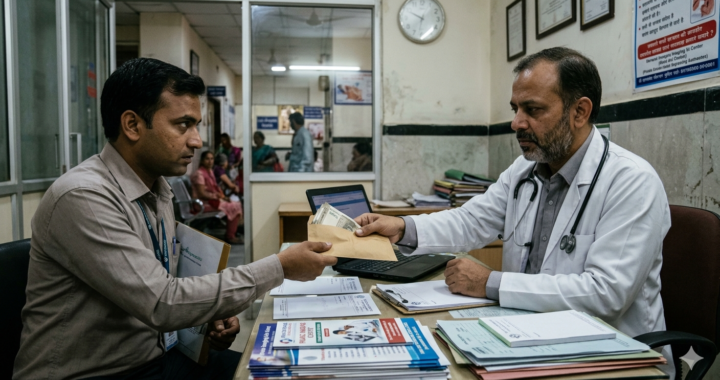
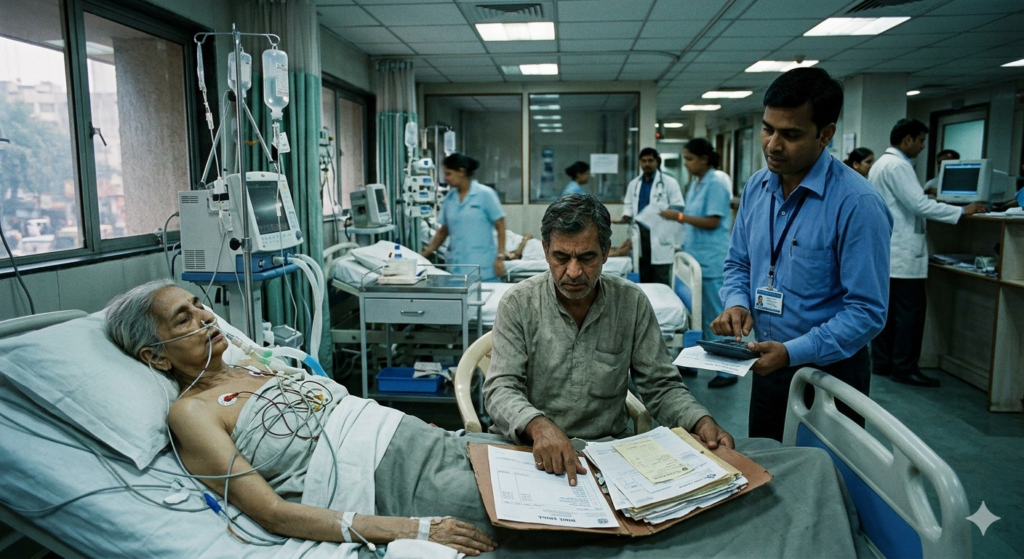
Once inside the ICU, the billing structure changes dramatically. A standard hospital room might cost ₹8,000–15,000 per day. An ICU bed in a major Delhi private hospital costs ₹18,000–35,000 per day before add-ons. Ventilators, oxygen, BiPAP machines, monitors, consumables, daily specialist rounds each billed separately, often at rates not disclosed upfront.
₹30K+
Daily ICU cost at a major Delhi private hospital (base rate)
₹1.56L
Average overcharge per patient at private hospitals (Maharashtra survey, 2,500+ patients)
75%
Private hospital patients overcharged, per large-scale Indian survey
10%
ICU patients at AIIMS estimated to be on life support with no clinical benefit
3. Emotional Hostage-Taking
Families are told: “If you discharge him, you’re giving up on him.” This is moral manipulation. The family’s grief is weaponised. They continue paying sometimes borrowing money, selling property because they believe stopping treatment means abandoning their loved one.
In reality, for a terminally ill patient, stopping futile ICU treatment is not giving up it is choosing dignity over prolonged suffering.
4. The Tube-and-Ventilator Strategy
As noted by senior physician Dr. Vijay Ajgaonkar in a documented account: terminally ill patients aged 70–80 are kept on ventilators with no chance of recovery, solely to inflate hospital bills. Tubes in the nose and mouth prevent the patient from speaking even if they want to say goodbye. Some deceased patients have reportedly been kept on ventilators to continue billing.
5. Blocking the Discharge
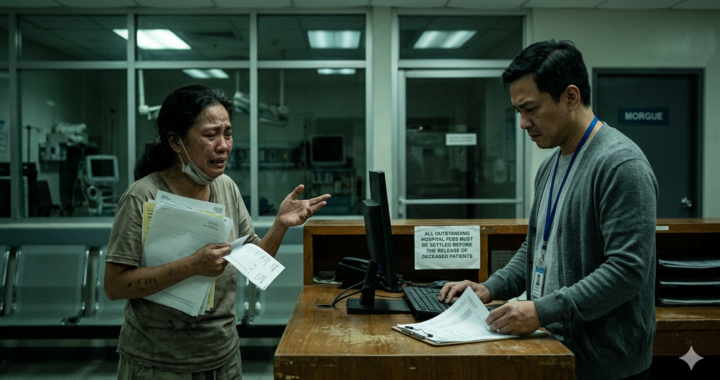
When families try to take their loved one home, hospitals may delay discharge with claims of “medical instability,” demand large advance payments before releasing the patient, or use the body as collateral refusing to release even a deceased patient until the bill is cleared.
Important to Know
Withholding a patient or body until the bill is paid is illegal under Indian law. Under the Consumer Protection Act, 2019, and established Supreme Court precedent, hospitals cannot hold patients hostage living or deceased over unpaid bills.
6. Unnecessary Procedures and Investigations
Terminally ill ICU patients are often subjected to daily blood panels, imaging scans, specialist consultations, and invasive procedures that have no therapeutic value at that stage of illness. Each generates a separate billing line. Families, under stress and trusting the medical system, rarely question these charges until they see the final bill.
Real Cases and Documented Evidence
These are not isolated incidents. They form a documented pattern across India’s private healthcare sector.
The ₹16 Lakh Heart Attack Bill
A documented case from a Delhi-area corporate hospital: a man died of a heart attack. The hospital drew up a bill of ₹16 lakh. The family could not afford it. Hospital management then hid the corpse. Police were eventually called to reclaim the body. The case, cited by social activist Harsh Mander, illustrates how the death of a patient does not end the exploitation.
The Terminal Cancer Patient
In another documented case, a patient with a terminal and incurable cancer diagnosis was prescribed an expensive treatment regime that the family’s own doctors later confirmed had no clinical benefit at that disease stage. The treatment continued until the patient’s death leaving the family financially devastated long after their loss.
Fortis Hospital, Gurugram: The ₹17 Lakh Dengue Bill
The Haryana government issued notices to Fortis Hospital after a dengue patient was billed approximately ₹17 lakh for 15 days in the ICU. While dengue is typically recoverable meaning this is not the same as a terminally ill case it illustrates how ICU billing can balloon to astronomical sums in private hospitals with minimal regulation.
Delhi Hospitals and the COVID Overcharging Crisis
During the COVID-19 pandemic, Delhi’s private hospitals were documented repeatedly violating government-capped ICU rates. The Delhi High Court noted that in one case, a hospital listed an ICU package of ₹30,000 per day and then billed separately for the BiPAP machine, oxygen, monitors, and other equipment that the court said “ought to have been part of the ICU package.” The bench called the matter of overcharging “serious.”
🔎 Expert Voice
“ICU care and high-tech interventions are meant for patients who have a reasonable chance of benefiting from it. Terminally ill patients do not. Their suffering may only be aggravated and prolonged by life-sustaining treatments. They die lonely in a medicalised environment when they need their family and familiar surroundings around them.”
The Financial Devastation on Families
The financial consequences of unnecessary ICU admissions reach far beyond the hospital stay itself. For middle-class and lower-income families in Delhi, a two-to-four week ICU admission for a terminally ill patient can produce bills between ₹5 lakh and ₹20 lakh or more.
| Cost Component | Approximate Daily Rate (Delhi, Private) |
| ICU Bed (NABH-accredited hospital) | ₹15,000–35,000 |
| Ventilator (if used) | ₹3,000–8,000 (often billed separately) |
| Specialist rounds (per visit) | ₹1,500–5,000 each |
| Daily lab investigations | ₹2,000–10,000 |
| Medicines and consumables | Variable, often marked up significantly |
| Imaging (CT, MRI, X-ray) | ₹5,000–25,000 per scan |
| Realistic total per day | ₹25,000–80,000+ |
Insurance companies where coverage exists also suffer. When private hospitals bill for unnecessary procedures, insurers pay inflated claims. Premiums rise for everyone. Patients without insurance face catastrophic out-of-pocket costs.
Beyond the financial impact, families describe lasting psychological trauma: guilt at having “let the hospital do all that,” anger at feeling deceived, and grief compounded by the knowledge that their loved one may have spent their final days alone in an ICU rather than at home surrounded by family.
💔 The Human Cost
“Several people for whom further treatment is futile are still hooked on to tubes and ventilators instead of being home with their families,” said Dr. Sushma Bhatnagar, Head of Onco-Anaesthesia and Palliative Care at AIIMS New Delhi adding that India “is one of the worst places when it comes to dying with dignity.”
What Indian Law and Government Guidelines Say
The legal and regulatory framework is clear and largely on the patient’s side. What is lacking is enforcement.
Ministry of Health ICU Guidelines (January 2024)
The Union Health Ministry’s first-ever national ICU admission norms, compiled by 24 critical care specialists, state explicitly:
- Hospitals cannot admit critically ill patients to the ICU if the patient or next-of-kin refuses
- Terminally ill patients where treatment will not impact survival should not be kept in the ICU
- Patients with a living will or advance directive against ICU care must not be admitted
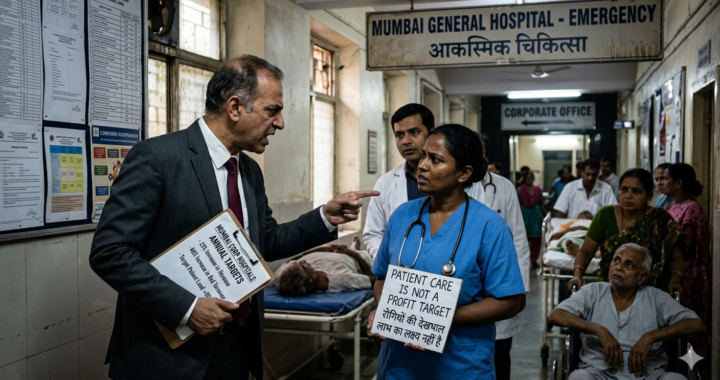
- Economic criteria alone should not be the deciding factor in keeping a patient in the ICU
Supreme Court: Common Cause v. Union of India (2018, Modified 2023)
The Supreme Court’s landmark ruling recognised the right to die with dignity. The judgment established that competent patients may refuse life-sustaining treatment, and doctors who comply with that refusal following due protocol are legally protected. A living will (advance medical directive) is legally valid in India under this ruling.
AIIMS End-of-Life Care Policy
AIIMS New Delhi developed India’s first institutional end-of-life care policy, which permits withholding or withdrawing life-sustaining treatment including ventilators when medical consensus confirms that treatment provides no benefit. Around 10 percent of ICU patients at AIIMS have been identified as being on life support despite having no clinical benefit from it.
Consumer Protection Act, 2019
Medical services provided for a fee are legally considered “services” under the Consumer Protection Act. Overcharging, providing services not rendered, and unfair trade practices by hospitals are grounds for consumer court complaints. Compensation of up to ₹50 lakh may be awarded.
Indian Medical Association v. V.P. Shantha (1995)
The Supreme Court established that patients paying for hospital services are “consumers” with legal rights to redress. This landmark ruling is the foundation of all medical consumer cases in India.
⚖️ Key Legal Principle
Passive euthanasia withdrawing or withholding futile life support from a terminally ill patient has been legally permitted in India since the Aruna Shanbaug case (2011) and reinforced by the Supreme Court in 2018. A doctor who continues aggressive, futile treatment against a patient’s expressed wishes may themselves be acting illegally.
Red Flags: Signs Your Loved One Is Being Exploited
These are warning signs that a private hospital in Delhi may be conducting unnecessary ICU care:
- No clear clinical explanation: Doctors cannot clearly explain how the ICU admission will improve the patient’s condition or survival
- Refusal to discuss prognosis honestly: You are not being told, in plain language, that recovery is unlikely or impossible
- Resistance to discharge or palliative care: The hospital discourages asking about home care, hospice, or palliative options
- Itemised bill is not provided: You are only shown a total, not a line-by-line breakdown of charges
- Daily procedures with no explanation: New scans, blood tests, or specialist visits are ordered every day with no explanation of their purpose
- Charges for items already in the ICU package: Oxygen, ventilator, monitors being billed as add-ons to the ICU room rate
- Pressure to sign consent forms quickly: Urgent consent for additional procedures without adequate time to ask questions
- Delays in providing discharge summary: Hospital makes it administratively difficult to leave
- Demands for large cash advances: Especially in an emergency setting, this is a red flag
- Different doctors visiting daily: Multiple specialist consultations, each separately billed, with no coordinating physician
Your Rights as a Patient or Family Member
Under Indian law and healthcare regulations, you the patient or legally authorised next-of-kin have the following rights:
| Right | What It Means | Legal Basis |
| Right to Refuse Treatment | You can refuse ICU admission, ventilators, or any aggressive treatment for a terminally ill family member | MoH Guidelines 2024; Common Cause SC 2018 |
| Right to Informed Consent | Every procedure requires your free, informed, written consent — and you can withdraw it | NMC Ethics Regulations 2002 |
| Right to an Itemised Bill | You are entitled to a complete, itemised bill before discharge | Consumer Protection Act, 2019 |
| Right to a Second Opinion | You can consult another doctor without hospital interference | NMC Ethics Regulations; MCI Charter |
| Right to Discharge | You can request discharge at any time. The hospital cannot hold the patient against your will | CPA 2019; Common Cause SC 2018 |
| Right to a Living Will | A valid advance medical directive must be honoured by treating physicians | Common Cause SC 2018, 2023 modification |
| Right to Palliative Care | You have the right to request transfer to palliative care at any point | ISCCM–IAPC Joint Policy Statement 2014 |
| Right to Complain | You can file a complaint with consumer courts, the Delhi DGHS, and the NMC | CPA 2019; NMC Act 2020 |
How to Fight Back: Step-by-Step Action Plan
If you believe your loved one is being subjected to unnecessary ICU care or being overcharged, here is what to do immediately and over the following weeks.
While Still in the Hospital
- Request an itemised bill immediately.
- Do not wait until discharge. Ask the billing department for a daily itemised statement. Note the date and time of the request hospitals are legally obligated to provide this.
- Ask the treating doctor directly: “What is the expected clinical benefit of continued ICU care?”
- Get the answer in writing if possible. If the doctor cannot provide a clear, evidence-based answer, that itself is informative.
- Request a patient care conference. Ask for a formal meeting with the treating intensivist, the primary consultant, and if available, a palliative care physician. Bring a trusted third party a family friend with medical knowledge, or another doctor you trust.
- Seek an independent second opinion.
- Contact AIIMS New Delhi or a government medical college hospital for an independent assessment. Tell them you are concerned about futile ICU care. Government hospital doctors are generally not financially incentivised to prolong treatment.
- Document everything.
- Photograph the patient’s medication labels, equipment, and bills. Keep a daily log of which doctors visited, what procedures were done, and what was explained to you. Note any pressure tactics.
- If you want to stop treatment, submit a written refusal.
- Write a clear letter stating that you as the legal next-of-kin withdraw consent for continued ICU care and request transition to comfort/palliative care. Keep a copy. The hospital is legally required to honour this request or formally document their reason for not doing so.
After the Hospital Stay: Filing a Complaint
| Forum | What to Complain About | How to File |
| District Consumer Forum | Overcharging, services not rendered, unfair billing | File a written complaint with evidence; fee ₹200–500. Claims up to ₹1 crore. |
| Delhi DGHS (Directorate of Health Services) | Regulatory violations, licence complaints, violation of ICU guidelines | Written complaint to the Director General, DGHS Delhi; online portal available |
| National Medical Commission (NMC) | Doctor misconduct, unethical billing practices by physicians | Online complaint at nmc.org.in; provide factual details and documentation |
| Delhi High Court (PIL/Writ Petition) | Systematic violations affecting multiple patients | Engage a consumer law advocate; PIL can be filed by any affected person |
| Insurance Ombudsman | Insurer refusing to act on overcharging evidence | File at irdai.gov.in or the regional insurance ombudsman office |
| Police (FIR) | Fraud, coercion, or deliberate billing for services not provided | File an FIR under IPC Section 420 (cheating) if clear evidence of fraud exists |
Documents You Will Need
- All original hospital bills and payment receipts
- Itemised bill (if obtained)
- Doctor’s letters, discharge summary, or any written communication
- Medical records and investigation reports
- Any written consent forms you signed
- Your written requests or refusals (if any were submitted)
- Witness statements from family members present during key conversations
💡 Pro Tip
Use the NPPA (National Pharmaceutical Pricing Authority) drug price database at nppa.gov.in to verify if medicines and devices were billed above their government-capped prices. This is one of the most common and easiest forms of overcharging to document.
The Humane Alternative: Palliative Care in Delhi
Palliative care is not giving up. It is a specialised, compassionate approach to medicine that focuses on comfort, pain relief, and dignity rather than cure. It is medically appropriate, legally valid, and increasingly recognised as the correct standard of care for terminally ill patients.
Palliative care can be delivered at home, in a hospice, or in a hospital ward without an ICU. It typically costs a fraction of ICU care. More importantly, it allows the patient to spend their remaining time with family, in familiar surroundings, free from tubes, machines, and the isolation of an intensive care unit.
Key Benefits of Palliative Care Over Futile ICU Care
| Factor | Futile ICU Care | Palliative Care |
| Patient comfort | Often poor — tubes, machines, restraints | Central goal — pain and symptom control |
| Family access | Severely restricted in ICU | Family present at all times |
| Patient dignity | Compromised by inability to speak or move | Maintained as a core principle |
| Cost | ₹25,000–80,000+ per day | ₹1,000–5,000 per day (home-based) |
| Outcome for terminal patient | No improvement in survival; increased suffering | Equal or better survival; reduced suffering |
| Family psychological impact | High anxiety, guilt, financial stress | Better satisfaction and lower grief scores |
Where to Access Palliative Care in Delhi
- AIIMS New Delhi
Department of Onco-Anaesthesia and Palliative Care (Dr. Sushma Bhatnagar’s team)
- Lok Nayak Jai Prakash Hospital
Government hospital with palliative services
- St. Stephen’s Hospital, Delhi
Well-regarded palliative care services
- Home-based Palliative Care
Several NGOs and specialist services operate in Delhi-NCR; ask your treating physician for a referral
- Pallium India (palliumindia.org)
National resource with Delhi contacts and legal guidance on end-of-life care
Research consistently shows that families of terminally ill patients who received palliative care instead of aggressive ICU treatment report less stress, less anxiety, and greater satisfaction with the care their loved one received even when, and sometimes because, the patient died sooner.
Frequently Asked Questions
Can I legally refuse ICU admission for my terminally ill family member in Delhi?
Yes. Under the Union Health Ministry’s 2024 ICU guidelines and the Supreme Court’s 2018 ruling in Common Cause v. Union of India, you as the patient or legally authorised next-of-kin have the right to refuse ICU admission. Submit your refusal in writing to the treating doctor. The hospital cannot override your informed refusal.
What should I do if a Delhi private hospital refuses to give me an itemised bill?
Make your request in writing and note the date. If the hospital refuses, this itself is a violation you can report. File a complaint with the District Consumer Forum under the Consumer Protection Act, 2019. Hospitals are legally obligated to provide itemised billing on request. You can also contact the Delhi DGHS and the Delhi High Court has ruled repeatedly that patients cannot be discharged without clear billing information.
Is a living will (advance medical directive) valid in India?
Yes. Following the Supreme Court’s 2018 ruling in Common Cause v. Union of India, an advance medical directive — stating your wishes about life support and aggressive treatment if you become incapacitated — is legally valid in India. The Court issued simplified procedures in a 2023 modification to make it easier to execute. A valid living will against ICU admission must be honoured by treating hospitals.
Can a hospital hold a deceased patient’s body until the bill is paid?
No. Withholding a body over an unpaid bill is illegal. Multiple courts, including the Delhi High Court and the Supreme Court, have ruled this constitutes coercion and a violation of the family’s legal rights. If this happens to you, call the local police immediately. File a complaint with the Delhi DGHS. The body must be released regardless of billing disputes.
How do I know if my family member’s ICU admission is unnecessary?
Ask the doctor directly: “What specific clinical improvement do you expect from ICU care, and in what timeframe?” If the answer is vague, or if the doctors use language like “we’re just monitoring” or “we can’t predict,” while your family member has a documented terminal diagnosis, this is a significant warning sign. Seek an independent second opinion from a physician at a government hospital such as AIIMS or Safdarjung Hospital, Delhi.
How much compensation can I claim for hospital overcharging in India?
Under the Consumer Protection Act, 2019, a District Consumer Forum can award compensation for overcharging, mental harassment, and service deficiency. In 2023, the NCDRC ordered Max Hospital to refund ₹5 lakh in an overcharging case. Fines on hospitals can reach ₹50 lakh for repeat offences. Success depends on your documentation keep every bill, receipt, and written communication.
What is “futile care” in medical terms?
Futile care refers to medical treatment that cannot reasonably be expected to achieve the patient’s goals particularly survival or recovery given the nature and stage of their illness. In the Indian legal and medical framework, futile care is defined as treatment that will not make a meaningful impact on outcome. The Ministry of Health’s 2024 ICU guidelines explicitly state that keeping terminally ill patients in the ICU when “continuation of therapy is not going to make an impact on the outcome, especially survival” is considered futile care.
Can I request a transfer from a private ICU to a government hospital or palliative care facility?
Yes. You have the right to request transfer at any time. The private hospital cannot legally prevent you from moving your family member to another facility. Obtain the patient’s medical records (you are legally entitled to copies), request a discharge summary, and arrange transport. If the hospital creates obstacles, put your request in writing and state that you will escalate to the Delhi DGHS if discharge is not facilitated promptly.
What is the role of palliative care, and is it covered by health insurance in India?
Palliative care focuses on comfort, dignity, and symptom management for patients with terminal or life-limiting illness not cure. Coverage under health insurance varies significantly by policy. Many standard health insurance policies in India do not cover home-based palliative care, though some newer policies have begun including it. Government schemes such as Ayushman Bharat (PM-JAY) do cover palliative care services. Review your policy and contact your insurer directly to confirm coverage.
Key Takeaways
ICU is not for the dying. Government guidelines are clear: terminally ill patients with no prospect of recovery should not be admitted to or kept in ICUs.
You have legal rights. You can refuse ICU care, demand itemised billing, and legally withdraw consent for treatment at any time.
Ask the hard question. “What clinical improvement do you expect, and in what timeframe?” If the doctor cannot answer clearly, seek a second opinion.
Document everything. Save every bill, note every conversation, and make every request in writing. This is your evidence if you need to file a complaint.
Palliative care is a valid medical choice. It is not giving up it is choosing dignity, comfort, and family time over prolonged, medicalised suffering.
Complain when it matters. Consumer courts, the Delhi DGHS, and the NMC all accept complaints against hospitals. Accountability starts with reporting.
Protect Your Family. Know Your Rights.
If you suspect unnecessary ICU care or overcharging, do not wait. Request an itemised bill, ask for a second opinion from a government hospital specialist, and contact the Delhi DGHS if your rights are being violated. You are not alone and you are not powerless.