

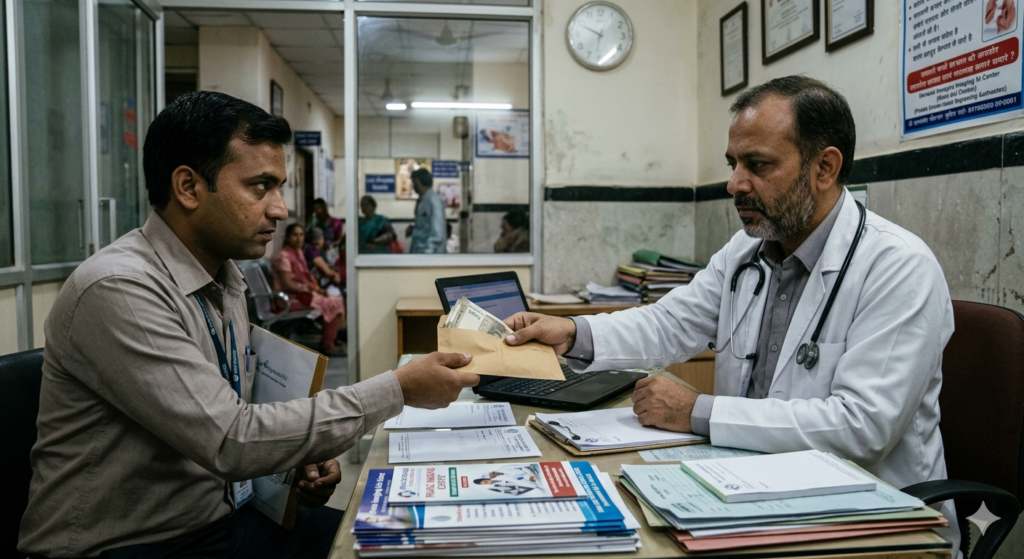
Cut Practice Exposed: The Diagnostic Referral Kickback Racket in India
This is “cut practice.” It’s one of Indian healthcare’s worst-kept secrets, and it has been hiding in plain sight for decades. Doctors, diagnostic labs, hospitals, and middlemen exchange a slice of your medical bill for sending patients their way. The Medical Council of India banned it in 2002. The National Medical Commission tried to ban it again in 2023. Yet it persists, because the system that enables it is bigger than any single regulation.
This guide breaks down exactly how the racket works, what the law actually says today, how to spot the warning signs, and what you can do if you suspect you’ve been a victim of it.
What Is Cut Practice?
Cut practice is the informal system in Indian healthcare where doctors, hospitals, or clinics receive a commission — a “cut” — for referring patients to a specific diagnostic lab, specialist, or hospital. The referral is based on the size of the kickback, not on what the patient actually needs. It is also known as fee-splitting or referral commission, and it has been formally prohibited under Indian medical ethics regulations since 2002.
The term itself is purely Indian medical slang. You won’t find “cut practice” in a Western medical ethics textbook, but the underlying problem — financial conflicts of interest in referrals — exists everywhere. India’s version is just unusually organised, with set commission rates, dedicated agents, and a parallel cash economy running alongside the formal healthcare system.
How the Diagnostic Referral Kickback System Actually Works
Cut practice didn’t appear overnight. It grew alongside India’s private healthcare boom, and it now runs on a fairly predictable structure.
The players involved
A handful of actors typically show up in every cut-practice chain:
- Referring doctors — usually general practitioners, family physicians, or specialists who see patients first and decide where to send them next.
- Diagnostic centres and pathology labs — these compete fiercely for patient volume and use commissions as a customer-acquisition tool.
- Hospitals and specialist clinics — they pay referral fees to GPs who funnel patients toward in-house surgeries, procedures, or admissions.
- Public relations officers (PROs) or “marketing executives” — agents employed by labs and hospitals specifically to negotiate and deliver commissions to doctors, often acting as a buffer so money never changes hands directly.
- Pharmaceutical and device representatives — a related but separate channel, where commissions are tied to prescriptions or equipment purchases rather than referrals.
How commissions are calculated and paid
Commissions are usually a straight percentage of the test or procedure cost, paid out monthly or weekly. According to multiple journalistic investigations and ethics studies conducted over the past decade, the commission percentage tends to scale with the cost of the test — the more expensive the scan, the bigger the cut.
| Test or Service | Reported Commission Range | Source / Context |
|---|---|---|
| Basic pathology tests (blood work, urine tests) | 5%–20% | Industry sources cited in regional investigations |
| Ultrasound and X-ray | 15%–30% | Multiple sting operations, 2014–2018 |
| CT scans | 20%–40% | News Nation TV sting operation, 2014 |
| MRI scans | Up to 50% | Same 2014 sting; corroborated by later reporting |
| Surgical or specialist referrals | 20%–30% of the procedure fee | Regional medical council complaints |
These figures vary by city, specialty, and how desperate a lab is for volume. They are best read as a directional pattern rather than a fixed national rate — no two markets behave identically.
A real-world example
In 2014, a Hindi news channel ran an undercover sting across Delhi diagnostic centres. Staff at one lab told undercover reporters they had standing kickback arrangements with roughly 10,000 doctors, with some neurosurgeons receiving tens of thousands of rupees a month for steering patients toward costly scans. The exposé triggered a national outcry. The then-Health Minister, Harsh Vardhan, publicly called it shameful and ordered an emergency probe by the Medical Council of India’s ethics committee, which eventually recommended de-empanelling nine implicated diagnostic centres from government and corporate referral panels.
That was over a decade ago. The mechanics exposed in that sting — cheque-based monthly payouts, PRO-brokered deals, and commission scaling with test cost — still describe how the system works today, according to ongoing reporting on healthcare fraud in India.
Why Cut Practice Persists in Indian Healthcare
If it’s banned, why hasn’t it disappeared? A few structural realities keep it alive.
- Private sector dominance. Private providers deliver roughly 80% of India’s healthcare, and they operate on commercial incentives rather than public health targets. Diagnostic services, in particular, are one of the fastest-growing and most competitive segments of the industry.
- Chronic public health underfunding. India’s public health spending has consistently sat well below the National Health Policy’s 2.5%-of-GDP target, pushing patients toward a private system with weaker oversight.
- A severe doctor shortage. India’s doctor-to-patient ratio lags behind the WHO benchmark, which concentrates enormous referral power — and bargaining leverage — in the hands of a relatively small pool of physicians.
- Weak, fragmented enforcement. Medical councils investigate complaints case by case, and a quiet handshake between two private individuals is almost impossible to police without a tip-off or a sting.
- Patient trust asymmetry. Most patients have no way to evaluate whether a test is clinically necessary. That information gap is exactly what makes the racket profitable.
- Normalisation within the profession. Multiple ethics researchers and whistleblowing doctors have described cut practice as something even ethical doctors can get pulled into gradually, simply because “everyone does it” in their local referral network.
The Hidden Cost to Patients
Cut practice isn’t a victimless arrangement between businesses. The commission has to come from somewhere, and it’s almost always built into your bill.
Estimates of the financial markup vary depending on who you ask and when the estimate was made:
- A study referenced in the Indian Journal of Medical Ethics estimated that around 20% of a patient’s total treatment cost is effectively transferred to the referring doctor.
- Healthcare commentators who have interviewed hundreds of practising doctors have put the realistic range closer to 20%–40% above the actual cost of care.
- Some physicians estimate patients pay 30%–50% more than the test or treatment should genuinely cost, once referral commissions are baked in.
Beyond inflated bills, cut practice creates a second, less visible cost: unnecessary medical risk. A doctor incentivised by commission has a reason to over-test, over-refer, or push patients toward more expensive procedures than their condition requires. Unneeded imaging means needless radiation exposure. Unneeded surgery means needless recovery time, complications, and expense. And every unnecessary test chips away at public trust in the system, which is part of why so many Indian patients now seek multiple “second opinions” before accepting a diagnosis — adding even more cost and delay to their care.
Is Cut Practice Illegal in India? The Legal and Regulatory Picture
This is the question almost every patient eventually asks, and the honest answer is: it’s complicated, and the rules have shifted recently. Here’s where things stand.
Professional misconduct under medical ethics regulations
Cut practice has been formally banned since the Indian Medical Council (Professional Conduct, Etiquette and Ethics) Regulations, 2002, specifically Regulation 6.4, which prohibits doctors from splitting fees or paying/receiving commissions for referrals. A doctor caught doing this can face disciplinary action from the relevant State Medical Council or the national regulator, ranging from a warning to suspension or, in serious repeat cases, removal from the medical register.
What changed in 2023 — and what didn’t
In August 2023, the National Medical Commission (NMC) — which replaced the old Medical Council of India in 2019 — notified a fresh set of rules, the National Medical Commission Registered Medical Practitioner (Professional Conduct) Regulations, 2023. These explicitly reinforced the ban on referral commissions and fee-splitting, and even attached specific punishment bands (ranging from one to three months’ suspension) to the offence.
Here’s the twist most articles on this topic miss: barely three weeks later, on August 23–24, 2023, the NMC put its own 2023 regulations on hold (in abeyance) following backlash over unrelated provisions (like mandatory generic prescribing). The NMC formally reinstated the old 2002 MCI Code of Ethics as the operative rulebook “until further notification.” As of now, that 2002 code — including its ban on fee-splitting — remains the legally binding ethics framework for doctors in India. The stricter 2023 version, with its explicit penalty bands, is technically suspended, not in force.
Criminal law angle
Disciplinary action by a medical council isn’t the same as a criminal case, and pursuing cut practice criminally is genuinely difficult. That said, depending on the facts, a few legal routes can apply:
- Cheating, under Section 318 of the Bharatiya Nyaya Sanhita, 2023 (which replaced Section 420 of the old Indian Penal Code from July 2024), can potentially apply if a patient was deliberately deceived into unnecessary tests for financial gain.
- Criminal conspiracy, under Section 61 of the Bharatiya Nyaya Sanhita (replacing Sections 120A/120B IPC), can apply where two or more parties — say, a doctor and a lab PRO — coordinate the scheme.
- The Prevention of Corruption Act, 1988 generally applies only to public servants, so it typically can’t be used against private-sector doctors unless a government hospital employee is involved.
- The Consumer Protection Act, 2019 allows patients to file complaints over deficient or unfair medical services, including unnecessary or unjustified tests, through consumer commissions or the e-Daakhil online portal.
- The Clinical Establishments (Registration and Regulation) Act, 2010 (adopted by several states) requires registered facilities to follow standard treatment protocols and gives patients a formal grievance channel against errant establishments.
In practice, most cut-practice cases never reach a courtroom. They’re settled — if at all — through medical council disciplinary proceedings, consumer forums, or simply media exposure.
Real Cases and Sting Operations That Exposed the Racket
| Year | Incident | Outcome |
|---|---|---|
| 2013 | Maharashtra physician Dr Himmatrao Bawaskar receives an unsolicited cheque from a diagnostic centre and publicly exposes it as a referral commission | Filed what is believed to be the first formal cut-practice complaint with the Medical Council of India |
| 2014 | News Nation TV sting across Delhi diagnostic centres reveals commissions of 30%–50%, including for MRI and CT scans | Health Ministry orders an emergency probe; MCI recommends de-empanelling nine implicated diagnostic centres |
| 2016–2018 | Multiple state medical councils, including Punjab’s, report a rise in complaints about PRO-brokered commissions for radiology referrals | Punjab Medical Council launches advisory campaigns and NGO partnerships to monitor the practice |
| 2023 | NMC notifies, then suspends within three weeks, new Professional Conduct Regulations that would have hardened penalties for fee-splitting | Old 2002 MCI ethics code reinstated as the operative law |
| 2025 | Hyderabad police bust a multi-accused healthcare fraud ring, including doctors, tied to a private hospital | Multiple arrests; case highlighted as part of a broader pattern of organised healthcare fraud in India |
The pattern across a decade of cases is consistent: a sting or whistleblower exposes the practice, regulators promise action, a few facilities get penalised, and the underlying system survives largely intact — because the financial incentive for the next lab or doctor never goes away.
Red Flags: Signs Your Doctor Might Be Engaging in Cut Practice
You can’t prove a commission arrangement just by sitting in a clinic, but certain patterns should make you pause and ask more questions.
- You’re referred to one specific lab or specialist, often outside the hospital premises, with no explanation of why that one and not another nearby option.
- The doctor seems reluctant or irritated when you ask to get the test done at a different, equally accredited facility.
- You’re prescribed a long panel of tests for a simple, common complaint that doesn’t usually require extensive workup.
- The referral slip lacks a clear clinical reason, or the doctor can’t explain in plain language why the specific test is needed.
- The diagnostic centre or specialist is run by a relative, business partner, or someone clearly connected to the referring doctor.
- You notice the same referral pattern repeating across multiple visits, regardless of changing symptoms.
- A “marketing executive” or agent from a lab has visited the clinic, or you spot promotional material for one specific diagnostic chain prominently displayed.
None of these signs alone proves wrongdoing — sometimes a single referral pathway exists because of genuine quality, convenience, or insurance tie-ups. But several of them together are worth a second look.
How Patients Can Protect Themselves
- Ask why, specifically. A direct question — “What exactly will this test tell us that we don’t already know?” — is one of the most effective filters against unnecessary referrals.
- Choose your own accredited lab. You are not obligated to use the lab your doctor recommends. NABL-accredited (National Accreditation Board for Testing and Calibration Laboratories) and NABH-accredited facilities meet independently verified quality standards, regardless of who refers you there.
- Get a second opinion for anything major. Before agreeing to surgery, an expensive imaging panel, or a long-term treatment plan, consult an independent specialist who has no referral relationship with your first doctor.
- Keep every prescription and referral slip. Documentation matters if you ever need to question a bill or file a complaint later.
- Compare prices across at least two providers. A significant price gap for the identical test, between two equally accredited labs, is worth investigating.
- Use trusted government or insurer-empanelled networks where possible. Empanelled facilities for schemes like Ayushman Bharat or CGHS undergo more structured oversight than purely private referral chains.
- Trust your instincts. If something about a referral feels off — rushed, vague, or oddly specific — it’s reasonable to pause and seek clarity before proceeding.
How to Report Cut Practice in India
If you genuinely believe a doctor took a kickback for your referral, here’s the realistic path forward.
- Document everything first. Save bills, prescriptions, referral slips, appointment records, and any communication that hints at a referral arrangement.
- File a written complaint with the State Medical Council where the doctor is registered. Every state has its own medical council with a grievance or ethics committee — this is the primary disciplinary route for cut practice as professional misconduct.
- Escalate to the National Medical Commission’s Ethics and Medical Registration Board if the state council doesn’t act, or if the matter involves cross-state facilities.
- File a consumer complaint through the National Consumer Helpline (1915) or the e-Daakhil portal if you were billed for unnecessary or unjustified services — this route can also seek financial compensation, not just disciplinary action.
- Contact the hospital’s internal grievance or ethics cell, if one exists — many larger private hospitals now maintain anti-graft or compliance committees specifically because of past scandals.
- Consider a Right to Information (RTI) request if a government-empanelled facility is involved, to obtain referral or billing records relevant to your case.
- Go to the press or a consumer rights NGO as a last resort if formal channels stall — historically, sting operations and journalistic exposés have driven more regulatory action on this issue than individual complaints alone.
What’s Being Done to Fight Back
The fight against cut practice isn’t purely top-down regulation. Several counter-forces are pushing back from within the system itself.
- Whistleblowing doctors like Dr Bawaskar have spent years publicly documenting and challenging the practice, often at professional and personal cost.
- The Indian Medical Association (IMA), the country’s largest doctors’ body, has repeatedly reaffirmed its Code of Medical Ethics’ stance against commission-based referrals, even while clashing with the NMC over other reform proposals.
- Hospital-level compliance and anti-graft committees have become more common, particularly at larger corporate chains that face reputational risk from scandals.
- Independent accreditation bodies like NABL and NABH give patients and referring doctors a quality benchmark that exists outside the commission economy entirely.
- Investigative journalism and sting operations remain, ironically, one of the most consistently effective enforcement tools — every major regulatory crackdown on this issue over the past decade has followed public exposure, not routine inspection.
Real change will likely require all of these forces working together: stronger and consistently enforced regulation, transparent referral disclosure rules, better public health infrastructure to reduce dependence on the private system, and patients who feel empowered to ask hard questions.
Frequently Asked Questions
What is cut practice in the medical field?
Cut practice is the practice of doctors or hospitals receiving a commission for referring patients to a specific diagnostic lab, specialist, or facility. It’s also called fee-splitting, and it has been formally banned under Indian medical ethics regulations since 2002.
Is cut practice illegal in India?
Yes, it counts as professional misconduct under the medical ethics regulations currently in force — the 2002 MCI Code of Ethics, Regulation 6.4. It can lead to disciplinary action by a State Medical Council, including suspension. Pursuing it as a criminal offence is harder and depends on specific facts like deception or conspiracy.
How much commission do doctors get for diagnostic referrals?
Reported figures vary widely by city and test type, but investigations and ethics studies over the years have cited ranges from roughly 5% on basic pathology tests up to 50% on high-cost scans like MRIs. These figures are not official rates — they come from sting operations, whistleblower accounts, and ethics research, and they fluctuate by market.
How can I tell if my doctor is giving me unnecessary tests?
Ask your doctor to explain, in plain language, exactly what each test will tell them and how it will change your treatment. Be more cautious if you’re sent to one specific facility with no clinical justification, or if the doctor resists you choosing an alternative, equally accredited lab.
What is the punishment for a doctor caught taking referral commissions?
Under the currently operative 2002 ethics code, punishment is decided case by case by the State Medical Council and can range from a warning to temporary suspension or, in severe or repeated cases, removal from the medical register. A 2023 NMC update had proposed fixed suspension periods of one to three months, but that update is currently suspended and not in force.
Where can I file a complaint about a doctor taking kickbacks?
Start with the State Medical Council where the doctor is registered. You can also approach the National Medical Commission’s Ethics and Medical Registration Board, file a consumer complaint through the National Consumer Helpline or e-Daakhil portal, or escalate to a hospital’s internal grievance cell if one exists.
Does the NMC currently ban referral commissions for doctors?
The NMC’s own 2023 regulations explicitly banned referral commissions with set penalty bands, but those regulations were put on hold weeks after being notified. The older 2002 MCI Code of Ethics — which also bans fee-splitting under Regulation 6.4 — is the rulebook currently in force.
Can I sue a hospital for prescribing unnecessary tests?
You can file a complaint through a consumer court or commission under the Consumer Protection Act, 2019, if you believe you were billed for medically unjustified services. You’ll need documentation such as bills, prescriptions, and ideally an independent medical opinion contradicting the original recommendation.
How do I get a genuine, unbiased second opinion?
Choose a specialist who has no business or referral relationship with your first doctor, ideally at a different hospital or practice altogether. Bring your existing test results and reports so the second doctor can evaluate your case without repeating costs unnecessarily.
Why doesn’t India just ban cut practice properly?
It’s already technically banned under medical ethics rules. The real challenge is enforcement — proving a private commission arrangement between two consenting parties is extremely difficult without a sting, whistleblower, or financial paper trail, and India’s fragmented, state-by-state medical council system makes consistent enforcement harder still.
Key Takeaways
Cut practice turns your doctor’s referral slip into a financial transaction you never agreed to. It’s been against medical ethics rules in India since 2002, reaffirmed (then suspended) by the NMC in 2023, and it survives mainly because enforcement depends on someone getting caught, not on routine oversight.
You can’t single-handedly fix a systemic problem, but you can protect yourself. Ask direct questions about why a test is necessary. Choose your own accredited lab. Get a second opinion before committing to anything major. Keep your paperwork. And if you genuinely believe you’ve been a victim of cut practice, don’t let it slide — a documented complaint to your State Medical Council or a consumer forum is one of the few things that has historically pushed this issue into the open.
Healthcare works best when trust isn’t a financial transaction. The more patients who ask questions, the harder this racket becomes to run quietly.
Found this useful? Share it with someone who’s about to walk into a diagnostic centre, and bookmark it for the next time a referral slip lands in your hands.


I know this if off topic but I’m looking into starting my own blog and
was wondering what all is required to get set up? I’m assuming having a blog like yours would cost a pretty penny?
I’m not very internet smart so I’m not 100% sure.
Any suggestions or advice would be greatly appreciated.
Thanks