
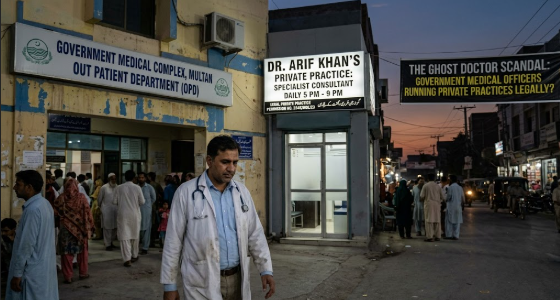
A patient walks into a government hospital at 11 a.m. The outpatient department is empty. The doctor’s chair is empty too. By 7 p.m., that same doctor is seeing forty patients an hour, three streets away, in a private clinic with his name in bold letters outside.
He isn’t hiding. He isn’t breaking any law that anyone is enforcing. He’s a “ghost doctor.”
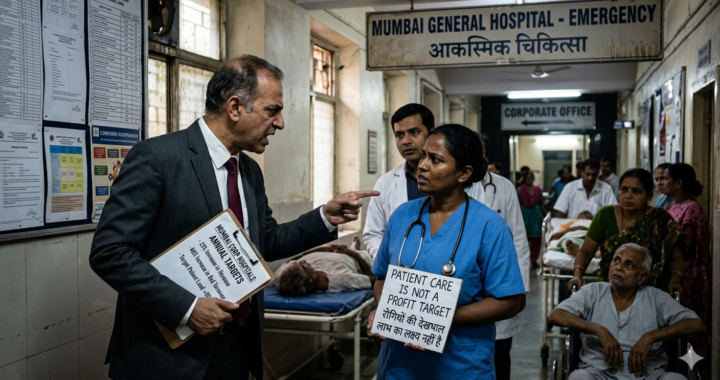
This is the strange part of the story that most headlines miss. The ghost doctor scandal isn’t only about absenteeism or corruption in the usual sense. It’s about a system that often makes private practice by government doctors technically legal, loosely regulated, or simply unenforced, even while official rules say otherwise. Patients lose access. Public money leaks out. And the doctors at the centre of it are rarely the ones who designed the loophole.
This guide breaks down exactly how the ghost doctor problem works, what the law actually says in Pakistan, India, and beyond, and what real reform looks like.
What Does “Ghost Doctor” Actually Mean?
The term “ghost doctor” gets used in a few different ways, and mixing them up causes a lot of confusion online.
In South Asia, a ghost doctor usually refers to a government medical officer who:
- Draws a full government salary, often including a special allowance for not practicing privately
- Is marked present on official attendance records
- Spends little or no real time treating patients at the assigned government facility
- Runs a thriving private clinic, hospital shift, or “on-call” consultancy elsewhere
In Larkana, Sindh, a preliminary administrative review found around 50 medical officers absent from duty for months across four major public hospitals, while their salaries kept being paid without interruption. Investigators estimated that close to 20% of doctors at the reviewed hospitals qualified as ghost employees. Some of these absentee doctors were reportedly earning monthly government salaries worth millions of rupees while performing no recorded duties.
Ghost Doctor vs. Ghost Employee vs. Ghost Surgery
These three terms sound similar but describe different problems. Don’t confuse them.
| Term | What it means | Where it’s common |
|---|---|---|
| Ghost doctor (South Asia) | A salaried public-sector doctor who is effectively absent from government duty while running a private practice | Pakistan, India |
| Ghost employee | Any government worker (not just doctors) drawn on payroll but not actually performing assigned duties | Public sector broadly |
| Ghost surgery / ghost doctor (South Korea) | An unlicensed substitute who secretly performs an operation in place of the surgeon a patient actually hired | South Korea’s cosmetic surgery industry |
The South Korean version is a separate, more dangerous phenomenon. There, a patient consents to surgery from a named surgeon, but an unlicensed substitute operates instead, often without the patient’s knowledge while they’re under anesthesia. Pakistani and Indian doctors who maintain private practice on the side, performing real operations under their own name, isn’t the same issue. The Pakistani and Indian “ghost doctor” controversy is about dual employment and accountability, not impersonation in the operating room. This article focuses on that South Asian, public-sector version.
How the “Legal” Private Practice Loophole Works
Here’s where it gets interesting. In most government health systems, doctors sign appointment terms that explicitly restrict private practice. So how does it stay legal, or at least unpunished, in practice?
1. The Non-Practicing Allowance (NPA) Trade-Off
In several Indian states, government doctors receive a Non-Practicing Allowance, typically 20–25% of basic pay, specifically to compensate them for giving up private income. The deal is simple on paper: take the allowance, skip the private clinic.
In reality, enforcement varies wildly by state and hospital. A review of healthcare governance across Indian states found that strict, well-enforced bans paired with NPA exist mainly at large central institutions like AIIMS, PGI Chandigarh, and major ESI and railway hospitals. Outside those flagship institutions, doctors sometimes collect NPA and still run informal private practices, leaving them legally exposed but rarely disciplined.
2. Institute-Based or Institutional Private Practice (IBP/IPP)
Pakistan took a different route: instead of just banning private practice, some provinces legalized a version of it.
Under Punjab’s Medical and Health Institutions framework, doctors at certain public hospitals are permitted to see private, fee-paying patients on hospital premises, usually in the evening, with the government taking a revenue share. This institutional private practice model was meant to give the public better access to specialists at controlled rates, while putting hospital infrastructure to use after hours and generating funds for upgrades.
The model already runs at flagship sites like the Punjab Institute of Cardiology in Lahore and the Rawalpindi Institute of Cardiology, and similar setups operate in Khyber Pakhtunkhwa and military-run hospitals. Provincial officials have pushed to expand this approach specifically because it formalizes income that was previously earned through unregulated private clinics outside hospital walls.
The catch: IBP is legal only inside the designated institution, during approved hours, with revenue sharing. A doctor running a separate private clinic across town, during duty hours, is doing something entirely different, and that part usually isn’t legal at all.
3. The Unenforced Ban: “Clause 6”
Most government medical officers in Pakistan’s provincial health departments sign an appointment letter containing a private-practice restriction. In Punjab, this restriction is written into clause 6 of the appointment letter, and it permits doctors to charge a consultation fee at their own residence or a patient’s home, but it does not allow them to operate a private clinic or hospital.
So technically, quietly seeing a patient at home for a fee sits in a legal gray zone. Opening an advertised private clinic, hiring staff, and running parallel OPD hours does not. Yet thousands of doctors do exactly that, because enforcement depends on inspections, complaints, and political will, all of which are inconsistent.
4. Proxy Names and Disguised Clinics
Investigations in Punjab, India, found doctors practicing under a spouse’s clinic name, advertising services without listing their own name in hospital treatment files, and taking informal on-call work at private hospitals during their government shift. One senior doctor was reportedly observed treating patients at a spouse’s clinic, while colleagues performed surgeries at private hospitals despite being on government duty rosters. This kind of structuring makes the practice harder to trace, even when hospital administrators privately know it’s happening.
Real Cases That Exposed the Scandal
| Location | What happened | Outcome |
|---|---|---|
| Larkana, Sindh (2025) | ~50 medical officers found absent for months across four hospitals; ~20% flagged as ghost employees | Preliminary report filed; reform pressure on hospital administration |
| Patiala, Punjab, India | Doctors found running private practice from home and at a spouse’s clinic, including staff assigned to COVID wards | Department issued warnings; principal pledged disciplinary action |
| Rajpura, Punjab, India | Anesthetists allegedly on informal arrangements with private hospitals, referring public patients there | Formal two-member inquiry committee ordered |
| Uttar Pradesh, India (2025) | Allahabad High Court noted doctors referring patients to private facilities for profit | Court directed the state government to draft a formal policy |
| Punjab, Pakistan (2018–2024) | Repeated cycles of “ban announced,” then “institute-based practice expanded instead” | Mixed: legal carve-out grew faster than enforcement of the ban |
A pattern shows up across nearly every case: complaints surface, an inquiry is announced, and enforcement fades once media attention moves on. That cycle is arguably the real scandal, more than any single doctor’s side income.
Is It Actually Legal? A Region-by-Region Breakdown
| Region | Official policy | Real-world enforcement |
|---|---|---|
| Punjab, Pakistan | Private clinics banned by appointment terms; institute-based practice legal inside hospitals | Ban widely ignored outside flagship institutes; IBP being expanded as the preferred fix |
| Sindh, Pakistan | Similar restrictions on duty-hour absence and unauthorized private work | Absenteeism scandals (Larkana) show weak attendance verification |
| Most Indian states with NPA | Private practice prohibited in exchange for the allowance | Strong at premier institutes (AIIMS, PGI); inconsistent elsewhere |
| Canada | Dual practice for medically necessary services is restricted by law in most provinces | Subject to ongoing legal challenges |
| China | Public sector doctors are formally barred from leveraging their post for private gain | Informal payments and under-the-table practice still documented |
| Greece | Dual practice was legalized in 2003 specifically to reduce informal, under-the-table payments | Formalized but still debated |
| Ethiopia (Tigray) | Dual practice was legally endorsed in 2010 as a retention tool for public hospitals | Studied as a deliberate trade-off, not a loophole |
Health economists generally describe this entire phenomenon as “dual practice,” and note that it’s permitted in most countries with mixed public-private health systems, with Canada and China standing out as the clearest legal exceptions. So Pakistan and India aren’t outliers globally. What makes their version controversial is the combination of weak attendance tracking, allowance payments tied to exclusivity promises, and patchy follow-through on complaints.
Why Government Doctors Turn to Private Practice
It’s tempting to frame this purely as greed. The real picture is more complicated.
- Pay gaps. Public-sector salaries, even with allowances, often trail what specialists can earn privately in a single evening clinic.
- Patient demand outpacing public capacity. Long OPD queues push patients toward private options, and doctors follow the demand.
- Weak monitoring infrastructure. Many hospitals still rely on manual attendance registers, easy to manipulate, instead of biometric or geo-tagged systems.
- Career incentives. Senior specialists who build private reputations gain referrals, teaching credibility, and negotiating power, separate from their government rank.
- Retention pressure on governments. Health ministries in many developing economies worry that strictly banning private income would push qualified doctors out of public service altogether.
None of this excuses unauthorized absence from duty. But it explains why so many governments choose to legalize and tax a version of the practice (institute-based models) rather than fight an unwinnable enforcement battle.
The Real-World Impact: Who Actually Pays the Price
Patients
Long waits at public hospitals push people toward private clinics they may not be able to afford. Worse, some doctors steer public patients toward private referrals, including their own clinics, raising direct conflict-of-interest concerns. The Allahabad High Court case is a clear example: judges specifically flagged doctors referring patients to private facilities for financial gain.
Public Finances
Every ghost doctor on full salary while privately practicing represents a direct drain on health budgets meant for frontline care. In the Larkana case alone, dozens of officers reportedly collected millions of rupees monthly in salaries tied to duties they weren’t performing.
Trust in the System
Once one scandal breaks, public confidence in the entire civil medical service takes a hit, even for the majority of doctors who do show up and follow the rules. That reputational cost is hard to reverse with a single inquiry report.
A Wider Pattern of “Ghost” Fraud in Healthcare
This isn’t only a South Asian story. A 2025 U.S. health care fraud crackdown charged 324 defendants, including 96 licensed medical professionals, across fraud schemes responsible for over $14.6 billion in losses. Different mechanics, same underlying theme: weak verification systems let “ghost” activity, whether ghost patients, ghost billing, or ghost duty hours, scale into massive financial losses before anyone notices.
What’s Being Done: Reforms Worth Watching
- Expanding institute-based practice. Rather than relying on bans alone, more provinces are formalizing evening private consultations inside public hospitals, with revenue shared for facility upgrades.
- Biometric and geo-tagged attendance. Several health departments are piloting fingerprint or facial-recognition check-ins to replace easily falsified manual registers.
- Independent healthcare commissions. Bodies like the Punjab Healthcare Commission can investigate complaints and refer findings to licensing authorities, giving patients a channel separate from internal hospital hierarchies.
- Court-ordered policy mandates. The 2025 Allahabad High Court direction shows judicial pressure can force governments to formalize rules that had existed only on paper.
- Transparent doctor registries. Pakistan’s medical regulator maintains a public registration database, letting anyone confirm whether a practicing doctor is actually licensed, a basic but underused safeguard.
How to Check or Report a Suspected Ghost Doctor
If you suspect a government doctor is improperly running a private practice, or simply want to verify credentials before a visit, you have real options:
- Verify registration. Look up the doctor’s name on the official medical council or commission portal to confirm an active, valid license.
- Check duty rosters. Government hospitals are required to display assigned OPD schedules; persistent absence during posted hours is reportable.
- File a written complaint. Health department complaint cells and healthcare commissions accept formal complaints about unauthorized private practice or duty-hour absence.
- Escalate through patient rights desks. Most teaching hospitals now have a designated grievance officer separate from hospital administration.
Documentation matters here. Dates, times, and any advertising material (signboards, social media posts) strengthen a complaint far more than a verbal report.
Frequently Asked Questions
Is it legal for government doctors to run a private clinic?
It depends on the rules in that specific province or state. Most appointment contracts ban operating a separate private clinic, but legal “institute-based practice” inside the government hospital itself is often permitted, and is different from an outside, unauthorized clinic.
What is a “ghost doctor” exactly?
In Pakistan and India, it refers to a government medical officer who draws a public salary while being effectively absent from assigned duties, often because they’re running a private practice elsewhere. It’s a different concept from South Korea’s “ghost surgery,” where an unlicensed substitute secretly performs an operation.
What is Non-Practicing Allowance (NPA), and does it ban private practice?
NPA is extra pay, often 20–25% of basic salary, given to compensate doctors for not practicing privately. Accepting NPA while still running a private clinic violates the terms in most states, even though enforcement against it is inconsistent.
How common is the ghost doctor problem?
It varies sharply by region and institution. A 2025 review in Larkana, Sindh, found roughly 20% of doctors at select hospitals qualified as ghost employees. Premier institutions with strict, monitored bans report far fewer cases.
Can patients actually report a government doctor for illegal private practice?
Yes. Health departments, healthcare commissions, and hospital grievance desks accept formal complaints. Providing dates, duty-roster mismatches, or advertising evidence makes a complaint far more actionable.
What is institute-based practice (IBP), and is it the same as the scandal?
No. IBP is a regulated, legal arrangement where doctors see private patients inside the government hospital, usually after hours, with a revenue share returned to the institution. The scandal involves practice outside this framework, off-site, untaxed, and often during duty hours.
What happens to doctors caught violating private practice rules?
Consequences range from formal warnings and salary deductions to suspension, depending on the jurisdiction and the severity of the violation. In practice, penalties are applied unevenly, which is part of why the problem persists.
Is this the same issue as doctor absenteeism in general?
They overlap but aren’t identical. Absenteeism covers any unauthorized absence; the ghost doctor scandal specifically refers to absence driven by parallel private practice, often involving salaries tied to an exclusivity promise like NPA.
Key Takeaways
The ghost doctor scandal isn’t a simple story of corrupt individuals. It’s a structural problem built from underpaid public posts, weak attendance verification, and policy responses that legalize a version of private practice faster than they enforce the ban on the rest of it. Institute-based practice models show that formalizing and taxing private consultations can work, when paired with real oversight. Without that oversight, every new rule just becomes another version of the same loophole.
If you’re a patient, the most useful thing you can do is verify a doctor’s registration before treatment, check posted duty rosters, and file a documented complaint if something doesn’t add up. Accountability in public healthcare starts with patients who ask the right questions, not just policymakers who write the next rule.