
You just took your blood pressure at home, and the reading stares back at you: 128/82. Is that fine? Or something to worry about?
Here’s the honest answer: it depends on your age, your health history, and how consistent that number is over time.
Blood pressure isn’t a single fixed target for everyone. A healthy reading for a 25-year-old looks different from a healthy reading for someone who’s 68. Yet most charts online treat every adult the same way, which leaves people either falsely reassured or needlessly panicked.
This guide fixes that. Below, you’ll find updated, medically reviewed blood pressure ranges for every age group — from newborns to seniors — plus clear explanations of what each number means, why blood pressure shifts as you age, and exactly when a reading calls for a doctor’s visit rather than a wait-and-see approach.
Key Takeaways
- Normal blood pressure for most healthy adults is below 120/80 mmHg, regardless of age.
- Average readings tend to rise with age due to natural stiffening of the arteries, but a “normal for your age” mindset can hide real risk.
- Blood pressure has five official categories: normal, elevated, Stage 1 hypertension, Stage 2 hypertension, and hypertensive crisis.
- Children and teens are assessed using height, age, and sex-based percentiles, not fixed numbers.
- A reading above 180/120 mmHg is a medical emergency — seek immediate care.
- One high reading isn’t a diagnosis. Doctors look at an average of several readings taken on separate days.
What Do Blood Pressure Numbers Actually Mean?
Every blood pressure reading has two numbers, written as one over the other — for example, 118/76 mmHg.
- Systolic pressure (top number): the force in your arteries when your heart beats and pushes blood out.
- Diastolic pressure (bottom number): the force in your arteries when your heart rests between beats.
Both numbers matter on their own. A normal top number with a high bottom number still counts as high blood pressure. The units, mmHg, stand for “millimeters of mercury,” a holdover from the mercury gauges early devices used.
Quick Snapshot: Official Blood Pressure Categories
This table applies to most adults and is the reference doctors use to decide on treatment, according to American Heart Association and American College of Cardiology guidelines.
| Category | Systolic (mmHg) | Diastolic (mmHg) | |
|---|---|---|---|
| Normal | Less than 120 | and | Less than 80 |
| Elevated | 120–129 | and | Less than 80 |
| Hypertension Stage 1 | 130–139 | or | 80–89 |
| Hypertension Stage 2 | 140 or higher | or | 90 or higher |
| Hypertensive Crisis | Higher than 180 | and/or | Higher than 120 |
If you hit the hypertensive crisis range, wait five minutes and retest. If the reading stays that high, especially alongside chest pain, shortness of breath, vision changes, or confusion, treat it as a medical emergency and call for help right away.
Normal Blood Pressure by Age: Full Reference Chart
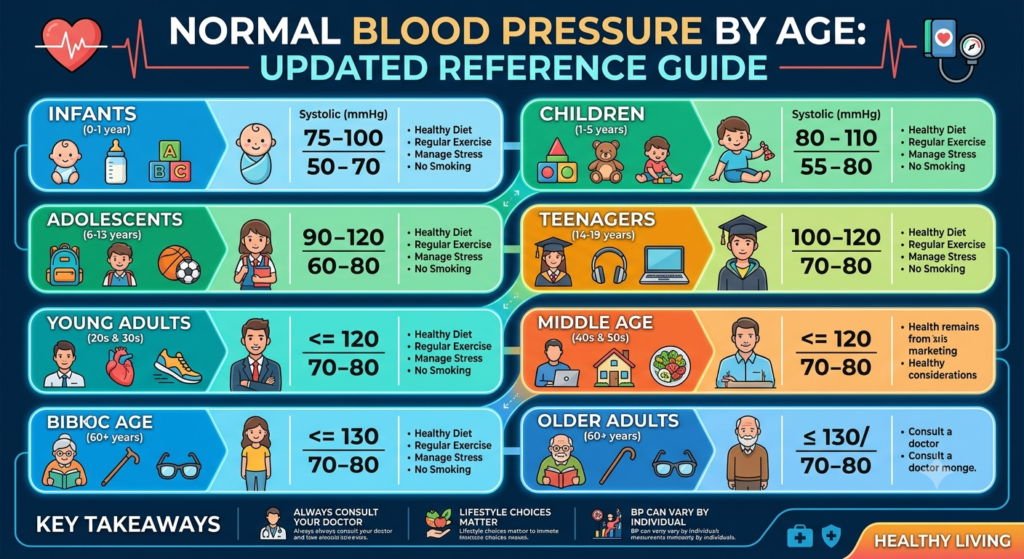
Average blood pressure climbs gradually across the decades. This happens because arteries naturally stiffen with age, a process called arteriosclerosis. But “average” isn’t the same as “ideal” — the healthiest target at every adult age still stays close to 120/80 mmHg or lower.
Children and Teens (Under 18)
Kids are never measured against a flat number. Instead, doctors compare a child’s reading to others of the same age, sex, and height using percentile charts. A reading is generally considered:
| Age Group | Typical Normal Range (Systolic/Diastolic) |
|---|---|
| Newborn (0–1 month) | 60–90 / 20–60 mmHg |
| Infant (1–12 months) | 87–105 / 53–66 mmHg |
| Toddler (1–5 years) | 95–110 / 53–66 mmHg |
| Child (6–13 years) | 97–112 / 57–71 mmHg |
| Adolescent (13–18 years) | 112–128 / 66–80 mmHg |
Notably, research from the American Heart Association suggests roughly 1 in 7 U.S. children may have higher-than-normal blood pressure, often linked to rising childhood obesity rates. Pediatric hypertension is increasingly common, which makes routine checks at well-child visits genuinely important, not just a formality.
Adults Ages 18–39
| Category | Systolic | Diastolic |
|---|---|---|
| Normal | Below 120 | Below 80 |
| Elevated | 120–129 | Below 80 |
| Stage 1 Hypertension | 130–139 | 80–89 |
| Stage 2 Hypertension | 140+ | 90+ |
Most healthy young adults sit comfortably between 110/70 and 120/80 mmHg. Arteries are typically at their most flexible during this stage of life, so readings creeping upward — even into the “elevated” zone — deserve attention rather than dismissal. This is the window where lifestyle habits set the trajectory for the next several decades.
Adults Ages 40–59
| Category | Systolic | Diastolic |
|---|---|---|
| Normal | Below 120 | Below 80 |
| Elevated | 120–129 | Below 80 |
| Stage 1 Hypertension | 130–139 | 80–89 |
| Stage 2 Hypertension | 140+ | 90+ |
The diagnostic thresholds don’t change with age — but the odds of crossing them do. This decade often brings the first noticeable creep in systolic pressure, driven by a mix of arterial stiffening, weight changes, and accumulated stress. Middle age is also when many people first hear the words “borderline” or “prehypertension” from a doctor.
Adults Ages 60 and Older
| Category | Systolic | Diastolic |
|---|---|---|
| Normal | Below 120 | Below 80 |
| Elevated | 120–129 | Below 80 |
| Stage 1 Hypertension | 130–139 | 80–89 |
| Stage 2 Hypertension | 140+ | 90+ |
The categories stay the same, but treatment targets often get personalized. Many guidelines support a treatment goal below 130/80 mmHg for adults 65 and older who are otherwise healthy and can tolerate it safely. For adults with multiple health conditions, limited life expectancy, or a high fall risk, a doctor may set a slightly less strict goal — sometimes below 140/90 or 150/90 mmHg — to avoid side effects like dizziness or fainting from over-treatment.
Expert insight: “A rising number on the cuff isn’t something to shrug off as ‘just aging.’ It’s associated with real cardiovascular risk at any age, and it’s one of the most modifiable risk factors we have,” notes cardiology guidance reflected across major heart-health organizations. Age-related increases are common — but common doesn’t mean harmless.
Blood Pressure During Pregnancy
Pregnancy temporarily changes the rules. Blood volume expands and blood vessels relax, so blood pressure often drops slightly in the first and second trimesters, sometimes reaching its lowest point around 20 weeks before climbing back toward baseline in the third trimester.
A reading of 140/90 mmHg or higher during pregnancy is flagged as gestational hypertension and needs prompt evaluation, since it can be an early sign of preeclampsia — a serious condition that also involves protein in the urine or other organ involvement. Regular prenatal blood pressure checks exist specifically to catch this early.
Why Does Blood Pressure Rise With Age?
Three main mechanisms drive the upward trend:
- Arterial stiffening. Elastic fibers in artery walls gradually get replaced with stiffer collagen. Stiffer arteries can’t expand as easily, so systolic pressure rises.
- Reduced elastic recoil. As arteries lose flexibility, the diastolic number can plateau or even drop slightly in older age, widening the gap between the two numbers — known as pulse pressure. A wide pulse pressure is itself a marker doctors watch closely.
- Cumulative lifestyle exposure. Decades of dietary sodium, weight changes, inactivity, and stress add up, compounding the natural stiffening process.
Hormonal shifts matter too. After menopause, women often see blood pressure rise more steeply, sometimes catching up to or surpassing rates seen in men of the same age — a shift linked to declining estrogen, increased sodium sensitivity, and faster arterial stiffening.
How to Get an Accurate Blood Pressure Reading
A single number can be misleading if it’s measured incorrectly. Follow these steps for a reliable reading:
- Sit still for 5 minutes before measuring — no talking, walking, or scrolling your phone.
- Keep your back supported and feet flat on the floor; don’t cross your legs.
- Rest your arm at heart level, supported on a table or armrest.
- Use the correct cuff size. A cuff that’s too small can inflate readings by 10 mmHg or more.
- Avoid caffeine, exercise, and smoking for 30 minutes beforehand.
- Take two or three readings, one minute apart, and use the average.
- Measure at the same time each day for the most useful home-tracking data.
Interestingly, up to 30% of people experience “white coat hypertension” — readings that spike only in a clinical setting due to nerves. The opposite, “masked hypertension,” is also real: normal readings at the doctor’s office but elevated numbers at home. This is exactly why home monitoring, done correctly, adds real value alongside clinic visits.
When Should You See a Doctor?
Don’t wait for symptoms — high blood pressure is often called the “silent killer” because it usually causes no warning signs until damage is already underway. Use these general guidelines:
| Situation | Recommended Action |
|---|---|
| Consistently 130/80–139/89 mmHg | Schedule a check-up within a few weeks |
| Consistently 140/90 mmHg or higher | See a doctor promptly, ideally within days |
| Above 180/120 mmHg, no symptoms | Retest in 5 minutes; seek care same day if it persists |
| Above 180/120 mmHg with chest pain, breathlessness, or vision changes | Call emergency services immediately |
| Reading below 90/60 mmHg with dizziness or fainting | Contact a healthcare provider |
Adults over 18 with normal readings should have blood pressure checked at least every two years. From age 40 onward, or if you have any elevated readings, annual checks — or more frequent home monitoring — are generally recommended.
Featured Snippet: What Is a Normal Blood Pressure Reading?
A normal blood pressure reading is below 120/80 mmHg for most healthy adults, regardless of age. This means a systolic pressure (top number) under 120 mmHg and a diastolic pressure (bottom number) under 80 mmHg. Readings above this level are classified as elevated, Stage 1, or Stage 2 hypertension, depending on how high they rise.
Practical Steps to Keep Your Blood Pressure in a Healthy Range
- Cut back on sodium. Aim for under 2,300 mg daily; under 1,500 mg is better if you already have elevated readings.
- Move most days. Even brisk walking for 30 minutes, five days a week, measurably lowers blood pressure over time.
- Watch your weight. Losing even 5–10 pounds can meaningfully reduce systolic pressure in people who carry extra weight.
- Limit alcohol. Heavy drinking is directly linked to higher readings.
- Manage stress. Chronic stress keeps the nervous system in a state that raises blood pressure long-term.
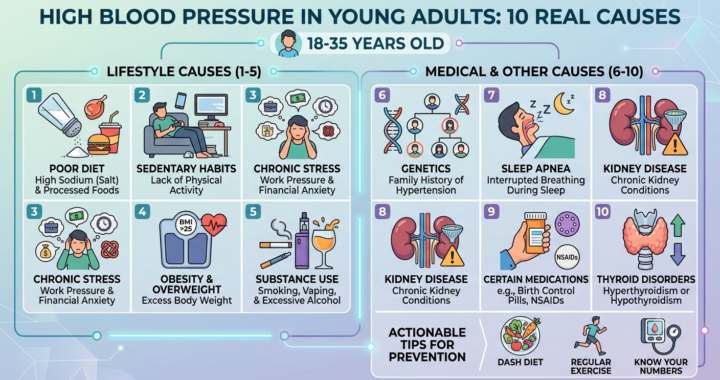
- Prioritize sleep. Poor sleep, especially untreated sleep apnea, is a frequently overlooked driver of high blood pressure.
- Don’t smoke. Nicotine causes an immediate, temporary spike and contributes to long-term arterial damage.
Frequently Asked Questions
What is a normal blood pressure by age chart based on? It’s based on large population studies and clinical guidelines from cardiology organizations, cross-referenced with age, sex, and — for children — height percentiles.
Is 120 over 80 a good blood pressure? 120/80 mmHg sits right at the upper edge of “normal” for most adults. It’s not concerning on its own, but it’s worth watching, since anything from 120–129 systolic (with diastolic under 80) is technically classified as elevated.
Is 140 over 90 blood pressure high? Yes. A reading of 140/90 mmHg or higher meets the criteria for Stage 2 hypertension and generally calls for both lifestyle changes and, often, medication.
What is the ideal blood pressure for a 60-year-old? Below 120/80 mmHg remains the ideal target, though many clinicians aim for below 130/80 mmHg in adults 60 and older, adjusting based on overall health, frailty, and fall risk.
Does blood pressure naturally rise with age? Average population readings do tend to climb with age, mainly due to arterial stiffening. However, this rise is linked to increased cardiovascular risk — it’s common, not automatically healthy, and it can often be slowed with lifestyle changes.
What blood pressure is considered too low? Generally, a reading below 90/60 mmHg is considered low. It only becomes a concern if it causes symptoms like dizziness, fainting, blurred vision, or fatigue.
What is stroke-level blood pressure? A reading above 180/120 mmHg is considered a hypertensive crisis and significantly raises the short-term risk of stroke. It requires immediate medical attention, especially with symptoms like severe headache or confusion.
How often should blood pressure be checked at different ages? Adults with normal readings should check every two years starting at 18. From 40 onward, or with any elevated reading, annual or more frequent monitoring is recommended.
Can home blood pressure monitors be trusted? Yes, when the monitor is clinically validated, the cuff fits properly, and it’s used with correct technique. Home readings often catch trends that a single office visit misses.
Why is my blood pressure different at the doctor’s office than at home? This is common and usually due to “white coat hypertension” (nerves raising readings in clinical settings) or, less often, “masked hypertension” (normal at the office, elevated at home). Both are reasons doctors increasingly rely on home monitoring data.
The Bottom Line
Blood pressure naturally shifts across a lifetime, but “normal for your age” shouldn’t be confused with “ideal.” For nearly everyone, the healthiest long-term target stays close to 120/80 mmHg or below. What changes with age isn’t the goal — it’s how much effort it takes to stay near it, and how personalized your treatment plan may need to become.
The single most useful thing you can do today is start tracking your own numbers consistently, using proper technique, and sharing that data with your doctor rather than guessing from a single reading. Small, steady habits — less sodium, more movement, better sleep — pay off in exactly the organ systems blood pressure protects: your heart, brain, kidneys, and eyes.
Talk to your doctor about your personal blood pressure targets, especially if your readings fall outside the normal range or you have other cardiovascular risk factors. This guide provides general, medically reviewed reference information — it isn’t a substitute for individualized medical advice.