
How Many Calories Should You Eat Daily? A Complete, Science-Backed Guide
Standing in front of the fridge, calculator in hand, wondering if 1,800 calories is too few or 2,400 is too many? You’re not alone. It’s one of the most searched health questions for a reason: the honest answer is “it depends,” but that doesn’t mean you’re stuck guessing.
Your daily calorie need isn’t a fixed number. It shifts with your age, sex, height, weight, activity level, and goals. The good news is that you can estimate it accurately in minutes using the same formulas dietitians and doctors rely on.
This guide breaks down exactly how many calories you need to maintain, lose, or gain weight. You’ll get the official USDA ranges, a step-by-step formula you can do yourself, and practical guidance for special situations like pregnancy, aging, and exercise.
Key Takeaways
- Most adults require 1,600 to 3,000 calories daily based on their age, sex, and physical activity.
- Females should consume 1,600 to 2,400 calories daily. Males should consume 2,000 to 3,000 calories daily.
- Mifflin-St Jeor equation provides the best formula to estimate your individual calorie requirement.
- A caloric deficit of 500 calories a day will result in about 1 pound of weight loss in a week.
- Consuming fewer than 1,200 calories (females) and 1,500 calories (males) without professional guidance can boomerang against you.
- Calorie quality is equally important as calorie quantity. People consuming “2,000 calories” may differ vastly in terms of health effects.
What Is a Calorie, Exactly?
A calorie is basically a measure of energy. Your body will convert the calories that you ingest into energy that powers your breath, thought, motion, and cell repair processes. All bodily activities ranging from blinking of your eyes to sprinting require energy.
Calories, per se, are neither good nor bad. It all depends on the calorie ratio and what they come from.
Average Daily Calorie Ranges
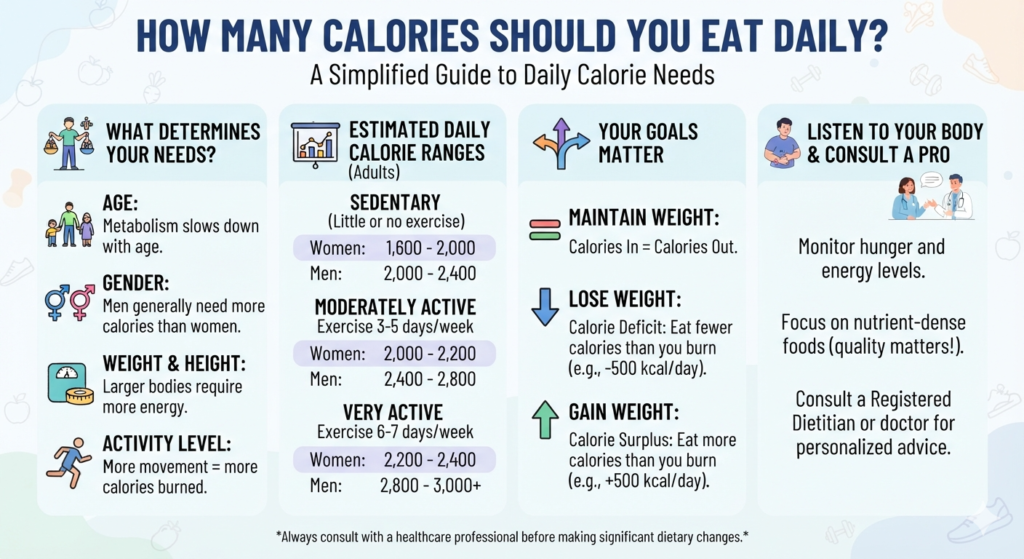
If you need a fast estimate before diving into the details, here’s the general range for adults, based on the Dietary Guidelines for Americans:
| Group | Sedentary | Moderately Active | Active |
|---|---|---|---|
| Women (19-30) | 1,800-2,000 | 2,000-2,200 | 2,400 |
| Women (31-50) | 1,800 | 2,000 | 2,200 |
| Women (51+) | 1,600 | 1,800 | 2,000-2,200 |
| Men (19-30) | 2,400-2,600 | 2,600-2,800 | 3,000 |
| Men (31-50) | 2,200-2,400 | 2,400-2,600 | 2,800-3,000 |
| Men (51+) | 2,000 | 2,200-2,400 | 2,400-2,800 |
Sedentary means minimal exercise beyond daily living. Moderately active means the equivalent of walking 1.5 to 3 miles a day. Active means the equivalent of walking more than 3 miles a day.
These numbers are estimates for maintaining current weight. Your exact number depends on your body size and metabolism, which is why a personalized calculation matters more than a chart.
How to Calculate Your Exact Calorie Needs (Step-by-Step)
Doctors and dietitians typically calculate calorie needs in two stages: first your Basal Metabolic Rate (BMR), then your Total Daily Energy Expenditure (TDEE).
Step 1: Calculate Your BMR
Your BMR refers to the amount of energy in terms of calories that your body consumes while resting. This has been estimated by using the formula known as the Mifflin-St Jeor equation, which was formulated way back in 1990.
Men: BMR = (10 × weight in kg) + (6.25 × height in cm) − (5 × age in years) + 5
Women: BMR = (10 × weight in kg) + (6.25 × height in cm) − (5 × age in years) − 161
Quick conversions: divide your weight in pounds by 2.2 to get kilograms. Multiply your height in inches by 2.54 to get centimeters.
Example: A 35-year-old woman who weighs 150 lbs (68 kg) and is 5’5″ (165 cm) tall has a BMR of: (10 × 68) + (6.25 × 165) − (5 × 35) − 161 = 1,376 calories
That’s roughly what her body burns doing nothing but existing.
Step 2: Multiply by Your Activity Level
Your BMR only covers rest. To find your true daily calorie burn, or TDEE, multiply your BMR by an activity factor.
| Activity Level | Description | Multiplier |
|---|---|---|
| Sedentary | Little to no exercise, desk job | BMR × 1.2 |
| Lightly active | Light exercise 1-3 days a week | BMR × 1.375 |
| Moderately active | Moderate exercise 3-5 days a week | BMR × 1.55 |
| Very active | Hard exercise 6-7 days a week | BMR × 1.725 |
| Extremely active | Physical job or twice-daily training | BMR × 1.9 |
Using the example above, if she’s moderately active: 1,376 × 1.55 = 2,133 calories a day to maintain her current weight.
Step 3: Adjust for Your Goal
Once you know your maintenance number (TDEE), adjust it based on what you’re trying to achieve.
- Maintain weight: Eat at your TDEE.
- Lose weight: Subtract 250 to 500 calories a day for a loss of roughly 0.5 to 1 pound per week.
- Gain weight or build muscle: Add 250 to 500 calories a day, paired with strength training.
Round your final number to the nearest 50 calories. These formulas estimate energy needs within about 10 percent accuracy, so precise, decimal-point tracking isn’t necessary or realistic.
Calorie Needs by Life Stage and Situation
General formulas are a strong starting point, but certain life stages change the equation.
Children and Teens
Children and teens require a sufficient number of calories for development rather than physical activity. The requirements may differ from 1,000 calories for young toddlers to 2,000 to 2,800 calories for active teen males. Due to the variety of growing rates, the calorie recommendations should be set by a pediatrician or a registered dietitian.
Pregnancy and Breastfeeding
Pregnant women generally don’t need extra calories in the first trimester, but need about 340 additional calories a day in the second trimester and 450 more in the third. Breastfeeding typically requires an extra 330 to 400 calories a day. These are averages, and an OB-GYN or dietitian should personalize the number.
Older Adults (60+)
The metabolism rate decreases as we age, mainly because of muscle atrophy. According to the National Institute on Aging, calorie requirements tend to reduce after the age of 60 regardless of physical activity. Nutrient requirements such as proteins and calcium will increase. Therefore, it is best for older individuals to consume more nutritious food.
Athletes and Highly Active People
Endurance athletes and people in physically demanding jobs can require 3,000 to 5,000+ calories a day. Timing calories around workouts, and prioritizing protein and carbohydrates, matters as much as the total number.
What Happens If You Eat Too Few Calories?
Severe calorie restriction feels like a shortcut, but it usually backfires. Registered dietitians commonly advise against dropping below:
- 1,200 calories a day for women
- 1,500 calories a day for men
…without direct medical supervision.
Eating too little can:
- Slow your metabolism as your body conserves energy
- Cause muscle loss instead of fat loss
- Lead to nutrient deficiencies, fatigue, and hair loss
- Trigger intense hunger and rebound overeating
- Disrupt hormones, sleep, and mood
If you’re not seeing results despite eating very little, the issue often isn’t willpower. It’s usually an unsustainable deficit that your body is actively resisting.
Calorie Quality Matters as Much as Quantity
Two people can eat exactly 2,000 calories and have completely different health outcomes. A diet of ultra-processed snacks and sugary drinks affects blood sugar, hunger hormones, and long-term health differently than a diet built around vegetables, lean protein, whole grains, and healthy fats.
The 2025-2030 Dietary Guidelines for Americans, released in January 2026, reinforce this point by pushing Americans toward whole, minimally processed foods and higher-quality protein sources, rather than focusing on calorie counts alone. “Empty calories,” meaning foods high in calories but low in nutrients, such as sugary sodas or fried snacks, are a common reason people feel hungry despite eating enough.
Practical swaps that keep calories in check without sacrificing nutrition:
- Swap sugary drinks for water, sparkling water, or unsweetened tea
- Choose whole fruit over fruit juice for more fiber and less sugar
- Add protein to each meal to stay full longer on fewer calories
- Choose whole grains over refined grains for steadier energy
Do You Need to Count Calories at All?
Counting calories works well for some people and feels exhausting or triggering for others. Registered dietitians increasingly recommend alternative approaches, especially for people focused on long-term habits rather than short-term numbers.
Alternatives to strict calorie counting:
- The plate method: Fill half your plate with vegetables, a quarter with lean protein, and a quarter with whole grains or starchy vegetables.
- Hunger and fullness cues: Eat slowly, and stop at roughly 80 percent full.
- Tracking apps for awareness only: Log food for a week or two to understand your current habits, then stop once you’ve built awareness.
- Habit-based goals: Focus on adding vegetables or protein rather than subtracting calories.
If counting calories feels stressful or leads to obsessive thoughts about food, it’s worth stepping back and talking to a registered dietitian about a different approach.
Common Mistakes People Make With Calorie Goals
- Copying someone else’s calorie target. Your friend’s 1,500-calorie plan may leave you undernourished if you’re taller, more muscular, or more active.
- Ignoring liquid calories. Coffee drinks, alcohol, and juices can add hundreds of hidden calories a day.
- Underestimating portion sizes. Studies consistently show people underestimate their intake, sometimes by several hundred calories a day.
- Cutting calories too fast. A 1,000-calorie daily deficit sounds efficient but usually leads to muscle loss and rebound weight gain.
- Not adjusting as weight changes. Your calorie needs drop as you lose weight, since a smaller body burns fewer calories at rest.
Frequently Asked Questions
How many calories should I eat a day to lose weight?
Most people lose weight steadily by eating 500 calories below their maintenance level, which typically results in about 1 pound of fat loss per week. For a woman with a maintenance level of 2,000 calories, that generally means eating around 1,500 calories a day. Never drop below 1,200 calories (women) or 1,500 calories (men) without medical guidance.
How many calories should a woman eat a day?
Most adult women need between 1,600 and 2,400 calories a day to maintain their weight, depending on age and activity level. Active women in their 20s may need closer to 2,400, while sedentary women over 50 often need closer to 1,600.
How many calories should a man eat a day?
Most adult men need between 2,000 and 3,000 calories a day to maintain their weight. Active men in their 20s and 30s often fall at the higher end, while sedentary older men typically need closer to 2,000.
Is 1,200 calories a day too low?
For most adults, yes. 1,200 calories is generally considered the minimum safe threshold for women, and it’s still low enough that it should only be followed under medical or dietitian supervision. Below this level, it becomes very difficult to get adequate protein, vitamins, and minerals.
How many calories should I eat to gain muscle?
To build muscle, most people need a surplus of 250 to 500 calories above their maintenance level, combined with regular strength training and roughly 0.7 to 1 gram of protein per pound of body weight. Eating in a large surplus doesn’t build muscle faster. It mostly adds fat.
Do I need to eat the same number of calories every day?
No. Calorie needs can be averaged over a week rather than hit precisely every single day. Some people prefer “calorie cycling,” eating slightly more on workout days and less on rest days, while keeping the weekly average consistent.
What’s the difference between BMR and TDEE?
BMR is the energy your body burns at complete rest. TDEE includes BMR plus the calories burned through daily movement, exercise, and digestion. TDEE is the number you should use when planning your actual daily intake.
Can eating too few calories stop weight loss?
Yes. Chronic under-eating can lower your metabolic rate over time, since your body adapts to conserve energy. This is sometimes called adaptive thermogenesis, and it’s one reason very low-calorie diets often stall after a few weeks.
The Bottom Line
There’s no single magic number that works for everyone. Your ideal daily calorie intake depends on your age, sex, body size, activity level, and goals, and it will shift as those factors change over time.
Start with the Mifflin-St Jeor formula to find your baseline, adjust based on your goal, and pay attention to how your body actually responds over several weeks. If you’re unsure, or if you have a medical condition, a registered dietitian can build a plan tailored specifically to you rather than relying on a generic chart.
Ready to put this into practice? Use the formula above to calculate your own TDEE today, then track your energy, hunger, and progress over the next two weeks. Small, sustainable adjustments beat drastic calorie cuts every time.