

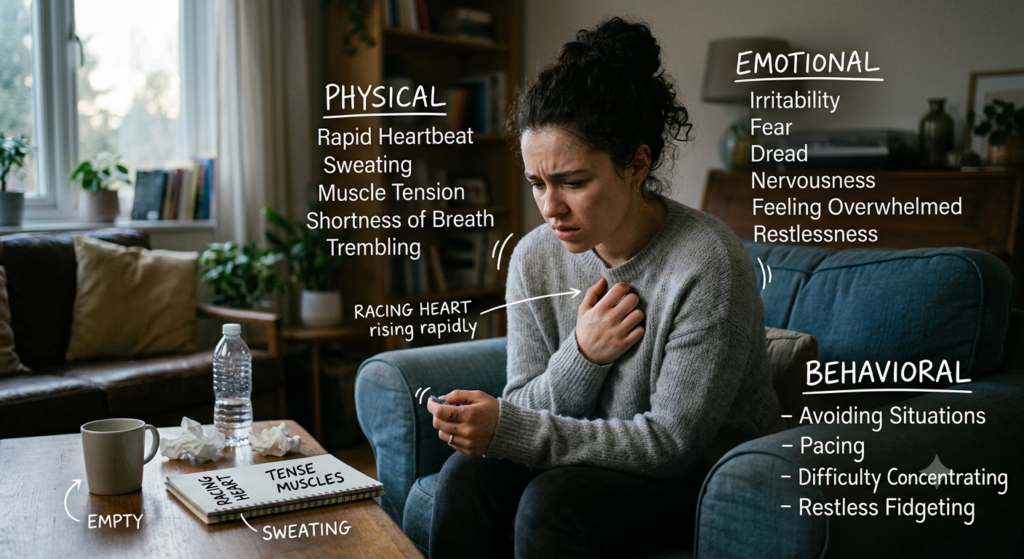
Understanding the Physical, Emotional, Cognitive, and Behavioral Signs of Anxiety
Anxiety Symptoms: Physical, Emotional, and Behavioral Signs
Your heart is pounding. Your stomach is in knots. You can’t stop replaying tomorrow’s meeting in your head, and you’ve cancelled plans with friends twice this month. Is this just stress, or is it anxiety?
Anxiety rarely announces itself with a single, obvious symptom. It shows up in your body, your emotions, your thoughts, and your behavior, often all at once. That’s exactly why it’s so easy to miss or misread. Many people spend years attributing racing hearts to caffeine, restlessness to a busy schedule, or irritability to a bad week, without ever connecting the dots.
About one in three adults will experience an anxiety disorder at some point in their life, according to the ADAA Yet many people wait years before recognizing what’s happening or seeking help.
This anxiety guide will go through all the aspects of anxiety symptoms physically, emotionally, and behaviorally to identify the symptoms of anxiety in yourself or those close to you. This article will help you understand what’s going on in your body during anxiety attacks and know when you have crossed into the realm of an anxiety disorder.
What Is Anxiety, Exactly?
Anxiety is your body’s natural alarm system. It’s designed to alert you to danger and prepare you to respond, a survival mechanism inherited from our earliest ancestors.
When your brain perceives a threat, real or imagined, it triggers the sympathetic nervous system. This is the “fight or flight” response. Adrenaline and cortisol flood your system, your heart rate climbs, your muscles tense, and your senses sharpen.
This response works well when there’s a real danger involved, such as swerving to avoid being in a car crash. However, the problem arises because the same alarm mechanism gets activated in the face of something that is not really dangerous – for instance, the deadline at work, meeting people socially, a concern about one’s health, or obsessive thoughts that you just can’t get out of your mind.
Every symptom covered below traces back to this same biological response. Understanding that connection can make the symptoms feel less random and more manageable.
The Four Categories of Anxiety Symptoms
Clinicians generally group anxiety symptoms into four overlapping categories:
- Physical (somatic) symptoms, what you feel in your body
- Emotional symptoms, what you feel inside
- Cognitive symptoms, how anxiety affects your thinking
- Behavioral symptoms, how anxiety changes what you do
Most people experience a mix from every category. Let’s go through each one in detail.
Physical Symptoms of Anxiety
The physical symptoms of anxiety are usually the most difficult, since they can mimic a health crisis almost identically. Physical symptoms during an onset of anxiety are actually one of the leading causes for individuals visiting the emergency room, only to find out that their heart and lungs are fine.
Why does this happen? Adrenaline diverts blood flow to muscles, increases heart rate and breathing rate, and slows down unnecessary processes, such as digestion. The body is not malfunctioning. It is functioning the way it should in reaction to a stimulus that should not really be there.
Common Physical Signs of Anxiety
| Symptom | Why It Happens |
|---|---|
| Racing or pounding heart | Adrenaline speeds up heart rate to pump blood to muscles |
| Shortness of breath or chest tightness | Faster, shallower breathing to increase oxygen intake |
| Muscle tension, aches, or headaches | Muscles brace for action and stay contracted |
| Sweating or hot flashes | The body attempts to cool itself during high alert |
| Trembling or shaking | Excess adrenergic activity in the nervous system |
| Nausea, stomach pain, or “butterflies” | Blood flow diverts away from digestion |
| Dizziness or lightheadedness | Changes in breathing and blood pressure |
| Fatigue or exhaustion | The body burns significant energy staying on high alert |
| Sleep problems | A hyperaroused nervous system resists winding down |
| Tingling or numbness in hands and feet | Rapid, shallow breathing can alter blood gas levels |
| Frequent urination or digestive changes | Stress hormones affect gut and bladder function |
Not everyone experiences all of these, and the mix can shift depending on the situation. A panic attack, for example, tends to bring several of these symptoms on suddenly and intensely, often peaking within about ten minutes.
Featured snippet answer: What are the physical symptoms of anxiety? The most common physical symptoms of anxiety are a racing heart, muscle tension, shortness of breath, sweating, trembling, nausea, dizziness, fatigue, and trouble sleeping. These occur because anxiety activates the body’s fight-or-flight response.
Emotional Symptoms of Anxiety
Emotional symptoms are less visible than physical ones, but they can be just as disruptive. They shape how you see yourself, other people, and the world around you, and they often reinforce the physical symptoms in a feedback loop.
Common emotional signs include:
- A persistent sense of dread or impending doom
- Feeling constantly on edge or “wired”
- Irritability or a short fuse
- Excessive, hard-to-control worry
- Fear of losing control
- Feeling detached from yourself or your surroundings
- A strong urge to avoid certain people, places, or situations
- Low self-confidence or self-doubt
- Restlessness or an inability to relax
These emotional symptoms often show up before you notice any physical changes. Many people describe it as an underlying hum of unease that colors everything else, even when nothing is objectively wrong.
Cognitive Symptoms Worth Knowing
Some experts separate cognitive symptoms from emotional ones, since they specifically affect thinking rather than mood. These include:
- Racing thoughts or an overactive mind
- Difficulty concentrating or “brain fog”
- Catastrophizing, jumping to worst-case scenarios
- Trouble making decisions
- Memory lapses under stress
- Intrusive or repetitive worried thoughts
If you’ve ever sat down to work and found your mind looping the same worry over and over, that’s a cognitive symptom of anxiety, not a lack of discipline or focus.
Behavioral Symptoms of Anxiety
Behavioral symptoms are the outward actions anxiety drives, often without you fully realizing why you’re doing them. These are frequently the symptoms other people notice first.
Common behavioral signs include:
- Avoidance, skipping events, calls, or situations that trigger anxious feelings
- Withdrawal from friends, family, or social activities
- Procrastination on tasks that feel overwhelming
- Reassurance-seeking, repeatedly asking others if things are okay
- Checking behaviors, like re-reading a sent email or checking locks multiple times
- Restlessness, pacing, fidgeting, or an inability to sit still
- Changes in eating, eating more or less than usual
- Increased use of alcohol, nicotine, or other substances to self-soothe
- Perfectionism or over-preparing to reduce uncertainty
- Difficulty completing routine tasks due to overwhelm
Behavioral symptoms often develop as coping mechanisms. Avoiding a stressful meeting feels like relief in the moment, but it can reinforce the anxiety over time by confirming, in the brain’s logic, that the situation really was something to fear.
Normal Anxiety vs. an Anxiety Disorder
Anxiety itself isn’t a problem. It’s a normal, adaptive emotion that sharpens focus, motivates preparation, and signals when something matters. The question isn’t whether you feel anxious. It’s whether that anxiety is proportionate, temporary, and manageable.
| Normal Anxiety | Anxiety Disorder |
|---|---|
| Tied to a specific, identifiable stressor | Often occurs without a clear trigger, or is disproportionate to it |
| Fades once the stressor passes | Persists for weeks or months |
| Doesn’t significantly disrupt daily life | Interferes with work, school, relationships, or sleep |
| Feels manageable with rest or coping strategies | Feels difficult to control despite your best efforts |
| Occasional physical symptoms | Frequent or intense physical symptoms, sometimes daily |
According to the American Psychiatric Association’s diagnostic guidelines, generalized anxiety disorder generally involves excessive worry occurring more days than not for at least six months, along with physical symptoms like restlessness, fatigue, or muscle tension. If that description sounds familiar, it’s worth discussing with a healthcare provider, not something to self-diagnose.
How Common Is Anxiety? The Numbers
Anxiety disorders are the most common mental health condition in the United States. A few figures put that into perspective:
- About 19% of U.S. adults experience an anxiety disorder in any given year, and roughly 31% will experience one at some point in their lives, per NIMH data.
- Women are affected at notably higher rates than men (roughly 23% versus 14% in past-year prevalence).
- Among people with an anxiety disorder, impairment ranges from mild in about 44% of cases to serious in nearly 23%, according to NIMH.
- An estimated 8% of children and teens experience an anxiety disorder, with most cases emerging before age 21, according to the Anxiety and Depression Association of America (ADAA).
- Social anxiety disorder alone affects around 15 million U.S. adults, and many people wait a decade or longer before seeking help for it.
These numbers matter for one reason: if you’re dealing with anxiety symptoms, you are far from alone, and effective treatment exists.
Anxiety Symptoms Across Different Groups
Anxiety doesn’t look identical in everyone. Recognizing how it shows up differently can help you catch it earlier, in yourself or someone you love.
In Children and Teens
Kids often can’t name what they’re feeling, so anxiety shows up as stomachaches, clinginess, trouble sleeping alone, meltdowns, school avoidance, or a sudden drop in grades.
In Men
Men are more likely to express anxiety through irritability, anger, or physical complaints, and are statistically less likely to acknowledge or report it, which can delay diagnosis.
In Women
Women report anxiety at nearly double the rate of men. Hormonal shifts, including those tied to the menstrual cycle, pregnancy, and postpartum periods, can influence symptom intensity.
In Older Adults
Anxiety in older adults is often mistaken for a medical issue or overlooked because it overlaps with physical conditions common in aging, such as heart disease or thyroid disorders.
When Anxiety Symptoms Need Medical Attention
Because physical anxiety symptoms can closely mimic serious medical conditions, it’s important to rule out other causes, especially the first time you experience them or if they change in pattern.
Seek prompt medical care if you experience:
- Chest pain, especially with shortness of breath or pain radiating to your arm or jaw
- Sudden, severe shortness of breath
- Fainting or near-fainting
- New numbness, weakness, or slurred speech
- A rapid or irregular heartbeat that doesn’t settle
- Symptoms that feel different or more severe than your usual pattern
The signs mentioned above can be associated with a panic attack, but they can indicate a medical emergency involving the heart or nervous system as well. Consulting a doctor is not an exaggerated step; it is just the right thing to do.
Beyond emergencies, it’s worth scheduling a routine appointment with a doctor or mental health professional if:
- Anxiety symptoms occur most days for two weeks or more
- Symptoms interfere with work, school, relationships, or sleep
- You’re avoiding activities you used to enjoy
- You’re using alcohol, food, or other substances to cope
- Physical symptoms have no clear medical explanation after evaluation
How Anxiety Is Diagnosed
There’s no single blood test or scan for anxiety. Diagnosis typically involves:
- A clinical interview covering symptoms, duration, and impact on daily life
- A physical exam and possibly lab work to rule out conditions like thyroid disorders, which can mimic anxiety
- Standardized screening tools, such as the GAD-7 questionnaire, to assess severity
- Review against diagnostic criteria from the DSM-5, the manual clinicians use to diagnose mental health conditions
A proper diagnosis matters because treatment differs depending on the specific type of anxiety disorder, whether that’s generalized anxiety disorder, panic disorder, social anxiety disorder, or another form.
Managing Anxiety Symptoms: What Actually Helps
Anxiety is highly treatable. Most people see meaningful improvement with the right combination of approaches.
- Therapy. Cognitive behavioral therapy (CBT) is the most well-researched treatment for anxiety disorders, and it works by helping you identify and reframe the thought patterns that fuel anxious feelings.
- Medication. For moderate to severe anxiety, a doctor may recommend medication such as an SSRI, often alongside therapy rather than as a standalone fix.
- Breathing and grounding techniques. Slow, diaphragmatic breathing can directly calm the nervous system during a spike in symptoms.
- Regular physical activity. Exercise helps metabolize stress hormones and has been shown to reduce anxiety symptoms in numerous studies.
- Consistent sleep habits. Poor sleep and anxiety fuel each other, so improving sleep quality often eases daytime symptoms.
- Limiting caffeine and alcohol. Both can intensify physical anxiety symptoms, even in people without a diagnosed disorder.
- Building a support system. Talking openly with trusted people reduces the isolation that anxiety often creates.
None of these need to happen perfectly or all at once. Small, consistent changes tend to outperform big overhauls that fizzle out after a week.
Frequently Asked Questions.
What are the first signs of anxiety
Early signs often include restlessness, difficulty concentrating, muscle tension, irritability, and trouble falling or staying asleep. These can appear gradually and are easy to dismiss as ordinary stress at first.
Can anxiety cause physical pain?
Yes. Anxiety commonly causes muscle tension, headaches, chest tightness, and stomach pain. This happens because stress hormones keep muscles contracted and disrupt normal digestive function.
How long do anxiety symptoms usually last?
Situational anxiety typically fades within minutes to hours once the stressor passes. Anxiety disorders involve symptoms that persist for weeks or months and don’t resolve on their own without treatment.
Can anxiety symptoms come on suddenly with no warning?
Yes. This is common with panic attacks, which can peak within about ten minutes and include a racing heart, chest tightness, and a sense of impending doom, even without an obvious trigger.
What’s the difference between stress and anxiety?
Stress is typically a response to an external pressure, like a deadline, and tends to ease once that pressure lifts. Anxiety can persist even after the stressor is gone and often involves excessive worry about future, sometimes unlikely, events.
Can anxiety symptoms mimic a heart attack?
Yes. Panic attacks can cause chest pain, a racing heart, sweating, and shortness of breath, symptoms that closely resemble a cardiac event. Any new or severe chest pain should always be evaluated by a medical professional to rule out cardiac causes.
Is it normal to have anxiety symptoms every day?
Occasional anxiety is normal, but daily symptoms that persist for two weeks or more, especially if they interfere with daily functioning, may indicate an anxiety disorder worth discussing with a professional.
Can children show behavioral symptoms of anxiety?
Yes. Children often express anxiety through stomachaches, irritability, clinginess, sleep problems, or avoiding school and social situations, rather than describing feelings of worry directly.
Key Takeaways
- Anxiety disorders can be grouped into four groups: physiological, emotional and cognitive, behavioral and most people experience anxiety in all these groups.
- Physiological symptoms like palpitations, muscle tension, and difficulty breathing are because of the body’s fight or flight mechanism.
- The emotional and cognitive symptoms of anxiety include constant worrying, irritability, racing thoughts, and difficulty concentrating.
- The behavioral symptoms are avoidance and withdrawal and may become coping strategies for dealing with anxiety.
- Normal anxiety is situational and transient; it has an identifiable source and goes away after the situation ends. Anxiety disorders are persistent and hard to control.
- Anxiety is the most common and most treatable psychological condition. Treatment methods include counseling, lifestyle changes and in some cases medications.
Next Step
If these symptoms sound familiar, you don’t have to figure it out alone. Talk to a doctor or licensed mental health professional about what you’re experiencing. An accurate diagnosis is the first real step toward feeling like yourself again
