
Walking vs Running: Which Burns More Fat?
You have thirty minutes and two choices: lace up for a run or head out for a brisk walk. One feels harder. One feels easier to stick with. But which one actually strips more fat off your body?
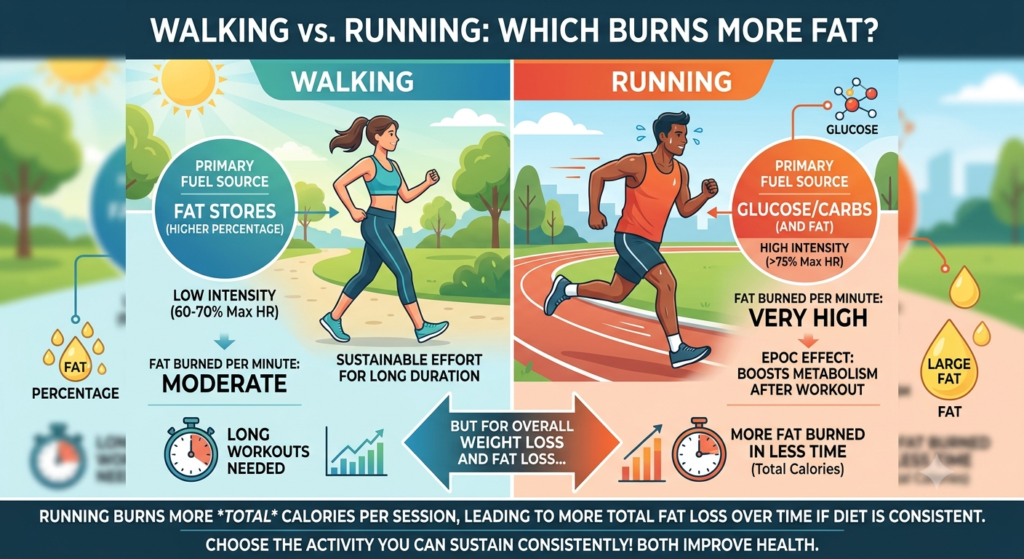
The honest answer is not as simple as “running wins.” Running burns more calories per minute. Walking uses a higher percentage of fat as fuel. And neither fact tells you the whole story.
This guide breaks down the real numbers, the physiology behind fat burning, and how to choose the workout that fits your body and your goals. No fluff, no guesswork, just what the research actually shows.
Calories burned by running per minute are more compared to walking. As such, this normally results in greater fat burning. But, walking uses more fat as an energy source compared to running while undertaking the activity. In most cases, fat loss is determined by the number of calories burned and not how the body gets its energy for exercise.
How Your Body Actually Burns Fat
Your body always uses a mix of fat and carbohydrates for energy. The ratio shifts depending on how hard you’re working.
- Low to moderate intensity (walking): Your body relies more heavily on fat because there’s enough oxygen available to break it down slowly.
- Higher intensity (running): Your body shifts toward carbohydrates because they release energy faster, which you need when you’re working harder.
This is where the popular “fat-burning zone” idea comes from. It’s a real physiological effect, but it’s often misunderstood.
The “Fat-Burning Zone” Myth
Gym treadmills often display a heart rate chart showing a “fat-burning zone,” usually around 60 to 70 percent of your max heart rate. At this intensity, your body does use a higher percentage of fat for fuel.
That is the catch. Increased percentage of a lower overall energy expenditure in fat does not mean burning more fat actually. Moderate-intensity exercise such as jogging may burn more fat in absolute numbers than slow-paced walking, despite its reduced percentage of fat used as fuel. The percentage and absolute number of something are two separate things, which constitutes the single largest myth on this matter.
What actually drives long-term fat loss is your total energy expenditure and consistency, not which “zone” you trained in.
Calories Burned: Walking vs Running (Real Numbers)
The table below shows estimated calories burned in a 30-minute session, based on standard MET (Metabolic Equivalent of Task) values used in exercise science. Your actual burn will vary based on fitness level, terrain, and technique.
| Activity | 130 lb (59 kg) | 155 lb (70 kg) | 180 lb (82 kg) |
|---|---|---|---|
| Walking, 3 mph (moderate) | ~107 cal | ~128 cal | ~150 cal |
| Brisk walking, 4 mph | ~153 cal | ~183 cal | ~214 cal |
| Jogging, 5 mph | ~254 cal | ~305 cal | ~357 cal |
| Running, 6 mph | ~300 cal | ~360 cal | ~421 cal |
| Running, 8 mph | ~360 cal | ~433 cal | ~507 cal |
Estimates based on standard MET values; individual results vary with body composition and effort level.
The pattern is clear. Running burns 2 to 3 times more calories than walking in the same amount of time. That’s why running has a reputation as the faster fat-loss tool.
So Which Burns More Fat: Walking or Running?
Both sides of this debate have solid evidence behind them. Here’s how each argument holds up.
The Case for Running
- Burns significantly more total calories in less time.
- Elevates your metabolism after your workout ends, known as EPOC (excess post-exercise oxygen consumption).
- Builds cardiovascular fitness and VO2 max faster than walking.
- More time-efficient for people with a packed schedule.
The Case for Walking
- Lower impact, which means lower injury risk and better long-term consistency.
- Easier to sustain daily without needing recovery days.
- Naturally uses a higher percentage of fat as fuel during the activity.
- More accessible for beginners, older adults, and anyone with joint concerns.
What the Research Really Shows
Another research that is worth mentioning has categorized people into walking, running, and cycling categories, where the training volume was equal among the categories per week. Interestingly, the group of walkers seemed to perform better on a long term basis compared to the other two. The reason for that was the adherence rate.
This is the part most articles skip. The “best” fat-burning exercise is the one you’ll actually do, week after week, for months. A perfect running plan you quit after two weeks burns zero fat. A decent walking habit you keep for a year burns plenty.
The Overlooked Option: Incline Walking
If you want a middle ground between walking and running, incline walking deserves serious attention.
A peer-reviewed study conducted in the International Journal of Exercise Science compared the viral workout “12-3-30,” which means 12 percent incline, 3 mph, and 30 minutes with steady pace running, having same number of calories burned in each
- Running burned calories faster, about 13 calories per minute versus 10 for incline walking.
- Incline walking pulled a higher share of energy from fat, around 41 percent, compared to 33 percent during running.
- Running relied more heavily on carbohydrates, which explains why runners often “carb load” before long races.
The trade-off: incline walking takes longer to burn the same total calories, and the study used a small sample of already-active adults. Still, if joint impact is a concern, walking on an incline is one of the most efficient ways to raise fat oxidation without the pounding of a run.
Factors That Actually Determine Fat Loss
Calories burned during a single workout is only one piece of the puzzle. These factors matter just as much, if not more:
- Total weekly calorie deficit – Fat loss ultimately comes down to burning more calories than you consume over time.
- Consistency – A moderate routine you keep for months beats an intense one you abandon after weeks.
- Diet quality – You cannot out-exercise a calorie surplus. Nutrition does most of the heavy lifting.
- Muscle mass – Strength training preserves lean muscle, which keeps your resting metabolism higher.
- Sleep and stress – Poor sleep and chronic stress raise cortisol, which can work against fat loss goals.
- Progressive overload – Gradually increasing pace, distance, or incline keeps your body adapting instead of plateauing.
Walking vs Running: Side-by-Side Comparison
| Factor | Walking | Running |
|---|---|---|
| Calories burned (30 min) | Lower | Higher |
| Fat used as fuel (%) | Higher | Lower |
| Injury risk | Low | Moderate to high |
| Beginner friendly | Very | Requires base fitness |
| Joint impact | Minimal | High |
| Time efficiency | Lower | Higher |
| Long-term adherence | Often higher | Can drop off |
| Equipment needed | Shoes | Supportive running shoes |
Which One Should You Choose?
There’s no universal winner. The right choice depends on your body, your schedule, and your history with exercise.
Choose Walking If
- You’re new to exercise or returning after a long break.
- You have joint pain, back issues, or are managing your weight.
- You’re over 50 with limited exercise experience.
- You want something you can do daily without needing recovery time.
- You prefer a sustainable, low-stress habit over intensity.
Choose Running If
- You already have a basic fitness foundation.
- You want faster results and have limited time to train.
- You enjoy higher-intensity workouts and recover well.
- You’re comfortable managing impact on your joints.
- You want to combine fat loss with cardiovascular performance gains.
The Smart Middle Ground
Most fitness coaches would suggest a combination of walking at a fast pace or incline walking every day, and doing one to two runs or interval training sessions during the week. It is the best way of combining the benefits of both activities.
How to Maximize Fat Burn, Whichever You Choose
- Add incline or hills. Even a 5 to 10 percent incline meaningfully raises calorie burn and fat oxidation.
- Try interval training. Alternating fast and slow segments burns more calories than a steady pace of the same duration.
- Extend duration gradually. Longer sessions burn more total calories, as long as you avoid overtraining.
- Train fasted occasionally, if appropriate for you. Some evidence suggests this can shift fuel use toward fat, though total calorie burn matters more overall.
- Strength train twice a week. Building muscle raises your resting metabolic rate, so you burn more even at rest.
- Track your progress. Use a fitness tracker or app to monitor pace, distance, and heart rate over time.
Common Mistakes to Avoid
- Chasing the “fat-burning zone” instead of total calories. A slower pace uses more fat percentage-wise but often burns fewer calories overall.
- Doing the same workout every time. Your body adapts quickly, so vary intensity, incline, and duration.
- Ignoring nutrition. No amount of walking or running offsets a consistent calorie surplus.
- Jumping into running too fast. Beginners who skip a walking base are more prone to shin splints and joint injuries.
- Expecting spot reduction. Neither walking nor running can target fat loss in one specific area, like the belly or thighs.
Frequently Asked Questions
Does walking burn belly fat? Walking can contribute to overall fat loss, including visceral (belly) fat, when combined with a calorie deficit. It cannot target belly fat specifically, since spot reduction isn’t physiologically possible.
Is 30 minutes of walking a day enough to lose weight? Thirty minutes of daily brisk walking can support weight loss, especially when paired with a modest calorie deficit and consistent habits. Results depend heavily on diet and overall activity level.
Is running better than walking for weight loss? Running typically burns more calories per minute, which can accelerate weight loss. Walking is often more sustainable long-term, and consistency frequently matters more than intensity.
How many minutes of walking equal running? As a rough guide, 30 minutes of running burns roughly the same calories as 45 to 60 minutes of brisk walking, depending on pace and body weight.
Does walking on an incline burn more fat than running? Research suggests incline walking can use a higher percentage of fat as fuel than running, though running still burns calories faster overall. Incline walking is a strong lower-impact alternative.
What burns more fat, walking or jogging? Jogging burns more total calories than walking in the same time frame, which typically leads to a greater fat-loss effect, provided you can sustain the higher intensity consistently.
Can you lose weight by walking every day without running? Yes. Many people lose meaningful weight through daily walking alone, especially when combined with a balanced diet and gradual increases in pace or distance.
How long should I walk to see fat loss results? Most people need 4 to 8 weeks of consistent walking, combined with a calorie deficit, before noticing visible fat loss. Individual timelines vary based on starting point and consistency.
Key Takeaways
- Calories burned are higher during running than walking when measured per minute.
- Fat provides a larger proportion of energy during walking than during running.
- It is not the form of exercise itself but the amount of calories burned that counts.
- Inclined walking is a good way to lose fat while reducing injury risk.
- It doesn’t matter which form of exercise is used as long as you stick to it.