
Best Exercises for High Blood Pressure: A Science-Backed Guide.
Nearly 1 in 3 adults worldwide lives with high blood pressure. Most don’t know a single daily habit can lower it as much as some medications: movement.
You don’t need to run marathons or spend hours in the gym. Recent research has actually turned old advice on its head a two-minute wall sit may do more for your numbers than a 30-minute jog.
This guide breaks down exactly which exercises work best, how much you need, and how to start safely — even if you’ve never exercised regularly before.
The type of exercises that will result in maximum decrease in average blood pressure is isometrics exercises such as planks and wall sit exercises, followed by aerobic and strength training exercises, dynamic resistance training exercises, aerobic exercises, and HIIT exercises.
How Exercise Lowers Blood Pressure
Every time you exercise, your blood vessels have to adapt. Over weeks and months, that adaptation becomes permanent change.
Regular activity lowers resting blood pressure through several mechanisms:
- Improves blood vessel elasticity, so arteries expand and contract more easily
- Reduces total peripheral resistance — the “tightness” of your blood vessels
- Lowers resting heart rate and increases stroke volume, so your heart works more efficiently
- Improves baroreceptor sensitivity, helping your body regulate pressure automatically
- Reduces stress hormones like cortisol and adrenaline that raise blood pressure
- Supports weight management, which independently lowers blood pressure
Even a single workout can trigger a temporary drop in blood pressure afterward, a phenomenon researchers call post-exercise hypotension. Do it consistently, and that temporary dip becomes your new normal resting pressure.
The Best Types of Exercise for High Blood Pressure, Ranked
The British Journal of Sports Medicine conducted an extensive meta-analysis study that involved 270 randomized control trials with more than 15,800 subjects. The exercise methods were tested against each other and ranked based on their ability to reduce resting blood pressure levels.
Here’s how they stacked up:
| Exercise Type | Avg. Systolic Reduction | Avg. Diastolic Reduction |
|---|---|---|
| Isometric exercise (wall sits, planks, handgrip holds) | −8.24 mmHg | −4.00 mmHg |
| Combined aerobic + resistance training | −6.04 mmHg | −2.54 mmHg |
| Dynamic resistance/strength training | −4.55 mmHg | −3.04 mmHg |
| Aerobic exercise (walking, running, cycling) | −4.49 mmHg | −2.53 mmHg |
| HIIT | −4.08 mmHg | −2.50 mmHg |
For context, a reduction in this range is comparable to what many people see from a single first-line blood pressure medication. That doesn’t mean exercise should replace medication — but it explains why doctors call it “a drug-free approach” to managing hypertension.
Let’s look at each category in more detail.
1. Isometric Exercise — The Surprise Frontrunner
Isometric training means holding a muscle contraction without moving, like pressing against a wall or holding a plank position.
The same meta-analysis found isometric wall squats specifically were the single most effective individual exercise for lowering systolic blood pressure of any exercise tested. A separate systematic review found isometric training reduced systolic pressure by 9.35 mmHg and diastolic pressure by 4.30 mmHg on average.
Why it works: While you perform the wall sit, your leg muscles remain contracted, and this causes constriction of the blood vessels within them. Upon cessation of the exercise, blood flow increases sharply, and this seems to condition the vascular system to relax effectively.
How to do a wall sit:
- Stand with your back flat against a wall
- Slide down until your knees form roughly a 90-degree angle, as if sitting in an invisible chair
- Hold the position while breathing normally — never hold your breath
- Aim for 2 minutes per hold
Sample protocol used in research: 3 sessions per week, 4 holds of 2 minutes each, with 1–2 minutes of rest between holds. That’s roughly 12–20 minutes of total exercise time per week — far less than standard cardio guidelines.
Examples of other isometric exercise include plank, hand grip squeeze using either a hand gripper or towel and isometric leg extension. Wall sit will offer relatively bigger losses compared to hand grip due to involvement of more muscles; however, hand grip exercise is ideal if you have restricted movement or if you work from a desk.
2. Combined Aerobic + Strength Training
Pairing cardio with resistance work — either in the same session or on alternating days — was the second most effective approach overall.
It does make physiological sense since aerobic exercise prepares your cardiovascular system, whereas strength training will make your muscles stronger for better metabolic function and blood glucose regulation, which are associated with blood pressure.
Example combined session: 20 minutes of brisk walking followed by 15 minutes of bodyweight strength exercises (squats, wall push-ups, seated rows with a resistance band).
3. Dynamic Resistance (Strength) Training
Lifting weights was once treated cautiously for people with high blood pressure, but current American College of Sports Medicine and American Heart Association guidelines now recognize properly prescribed resistance training as a valuable, safe component of hypertension management.
Strength training temporarily raises blood pressure during a lift, which is normal. Over time, though, it improves overall fitness and body composition in ways that lower resting blood pressure.
Guidelines for safe strength training with hypertension:
- Use moderate weight — one you can lift 10 to 15 times before fatigue
- Avoid maxing out or lifting to failure
- Exhale during the exertion phase of each lift; never hold your breath (this prevents the Valsalva maneuver, which can spike blood pressure dangerously)
- Rest 60–90 seconds between sets
- Train major muscle groups 2 days per week, on non-consecutive days
4. Aerobic Exercise
Cardiovascular (“cardio”) exercise has been the most researched and the most recommended type of exercise for high blood pressure treatment, although doctors generally recommend starting from basics.
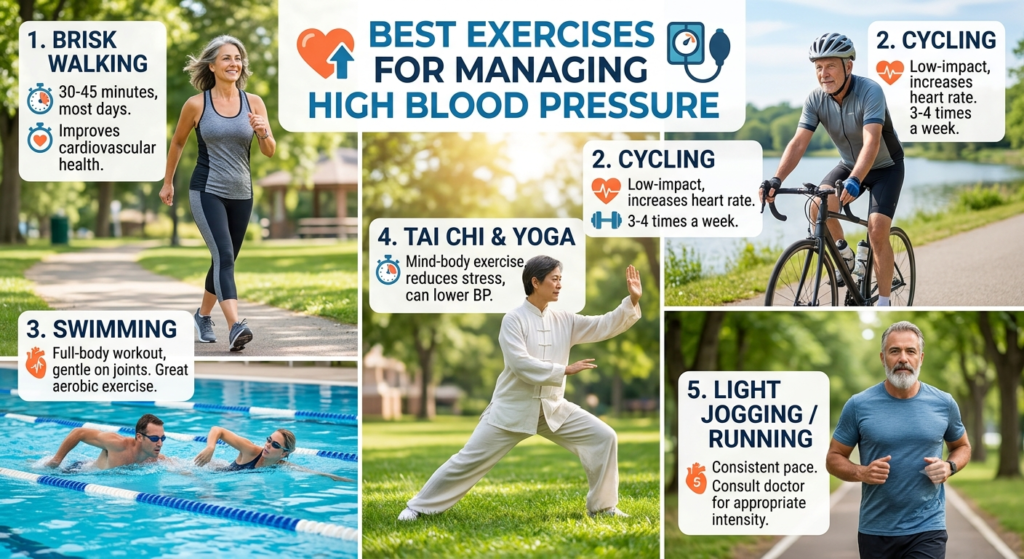
In one study, swimmers who slowly worked themselves up to 45 minutes of continuous swimming experienced, on average, a reduction of 9 mm Hg in their systolic blood pressure over a period of 12 weeks.
It appears that not only the frequency but also the duration of aerobic exercise may be significant. In one study, participants were more likely to have fewer episodes of increased blood pressure during a day if they did 3 separate 10-minute walks rather than 1 long 30-minute walk.
5. High-Intensity Interval Training (HIIT)
HIIT alternates short bursts of intense effort with recovery periods — for example, 30 seconds of fast cycling followed by 90 seconds of easy pedaling, repeated for 15–20 minutes.
It produced the smallest average reductions of the five categories in the meta-analysis above, but it’s still an effective, time-efficient option, especially if you’re already fit and cleared by your doctor for higher-intensity training.
How Much Exercise Do You Actually Need?
The American Heart Association’s foundational recommendation for managing blood pressure is:
- 150 minutes of moderate aerobic activity per week (or 75 minutes of vigorous activity), plus
- Muscle-strengthening activity on 2 or more days per week
This translates to roughly half an hour each day, for five days a week – a quantity that most individuals can incorporate into their daily routine. Sustainability rather than intense exercises is key here, as the results attained from exercises have been seen to be undone in about two weeks.
If isometric exercises are incorporated, there have been findings that just three training sessions in a week will yield results, usually within 4 to 8 weeks of consistent exercise routines. Some have seen the benefits realized even in three weeks.
A Sample Weekly Plan
Here’s a balanced week that combines the highest-impact exercise types:
| Day | Activity |
|---|---|
| Monday | 30-min brisk walk + 3 x 2-min wall sits |
| Tuesday | Strength training (major muscle groups, moderate weight) |
| Wednesday | 30-min brisk walk or swim |
| Thursday | Rest or gentle yoga/stretching |
| Friday | 3 x 2-min wall sits + handgrip holds |
| Saturday | Combined session: 20-min walk + bodyweight strength circuit |
| Sunday | Rest or light activity (yard work, easy cycling) |
Adjust based on your fitness level, doctor’s guidance, and how your body responds.
Exercise Safety: What to Watch For
Exercise is one of the safest, most effective tools for managing blood pressure — but a few precautions matter, especially if your blood pressure is currently uncontrolled.
Before starting, talk to your doctor if:
- Your blood pressure is above 180/110 mmHg (a hypertensive crisis range)
- You have chest pain, an irregular heartbeat, or a history of heart disease
- You’re new to exercise and have other health conditions
Stop exercising immediately and seek medical care if you experience:
- Chest pain or pressure
- Unusual shortness of breath
- Dizziness or lightheadedness
- Pain radiating to your neck, jaw, arm, or shoulder
General safety tips:
- Warm up for 5 minutes before intense activity and cool down afterward
- Breathe continuously during strength and isometric holds — never hold your breath
- Start at moderate intensity: you should be able to talk in short sentences during aerobic exercise
- Avoid fast-paced “hot yoga” or extreme heat exposure during exercise
- Track your blood pressure with a home monitor to see your progress and catch any concerning changes early
Exercise Works Best With Other Lifestyle Changes
Movement is powerful, but it works best as part of a broader approach. Pair your exercise routine with:
- The DASH diet (Dietary Approaches to Stop Hypertension) — emphasizes vegetables, fruits, whole grains, and low sodium intake
- Reduced sodium intake — aim for under 2,300 mg per day, ideally closer to 1,500 mg if you have hypertension
- Limited alcohol
- Consistent sleep — poor sleep is independently linked to higher blood pressure
- Stress management — techniques like deep breathing, tai chi, and meditation
Frequently Asked Questions
What is the single best exercise for high blood pressure? Based on current research, isometric wall sits produce the largest average reduction in systolic blood pressure of any single exercise tested — roughly 8 to 10 mmHg with consistent practice.
How long does it take for exercise to lower blood pressure? Most studies show measurable reductions within 4 to 8 weeks of consistent training, 3 or more sessions per week. Some people see changes in as little as 3 weeks, while a single workout can produce a short-term drop that fades within hours.
Can exercise alone lower blood pressure without medication? For many people with mild to moderate hypertension, consistent exercise can lower systolic pressure by 5 to 10 points and diastolic pressure by 3 to 6 points — sometimes enough to reduce medication needs under a doctor’s supervision. It shouldn’t replace prescribed medication without medical guidance, though.
Is walking enough to lower blood pressure? Yes. Brisk walking for 30 to 45 minutes most days of the week is safe and effective for most people, and it remains one of the most well-studied exercises for hypertension. Adding isometric or strength training alongside it produces even greater benefits.
Are wall sits safe for people with high blood pressure? For most people with mild to moderate hypertension, yes. Wall sits cause a temporary rise in blood pressure during the hold itself, but the long-term training effect is a meaningful reduction in resting blood pressure. If your blood pressure is above 180/110 mmHg or uncontrolled, check with your doctor first.
Is running or strength training better for blood pressure? Running was found to be the most effective individual aerobic exercise for lowering diastolic blood pressure, while isometric wall squats led for systolic pressure. A combination of both aerobic and resistance work is generally recommended over relying on just one type.
How often should I exercise to control blood pressure? The American Heart Association recommends at least 150 minutes of moderate aerobic activity per week, plus strength training on 2 or more days. Isometric exercise research supports 3 sessions per week as sufficient for measurable results.
What exercises should I avoid with high blood pressure? Avoid maximal-effort weightlifting, holding your breath during exertion (the Valsalva maneuver), and intense hot yoga. These can cause sharp, temporary blood pressure spikes. Moderate, controlled exercise with steady breathing is safer and just as effective long-term.
Key Takeaways
- Isometric exercises like wall sits and planks currently show the strongest evidence for lowering blood pressure, with effects comparable to some medications.
- A combination approach — aerobic activity, strength training, and isometric holds — outperforms relying on any single exercise type.
- Consistency beats intensity. Meeting the 150-minutes-a-week aerobic guideline, plus 2 days of strength training, is more valuable than occasional intense workouts.
- Safety matters. Breathe continuously, avoid maximal effort, and check with your doctor if your blood pressure is significantly elevated or uncontrolled.
- Exercise works best combined with a low-sodium diet, good sleep, and stress management.
Ready to get started? Pick one aerobic activity and one isometric exercise from this guide, block out 20 minutes today, and begin. Track your blood pressure weekly so you can see your progress build and always loop in your doctor before making changes to your exercise routine or medication.