
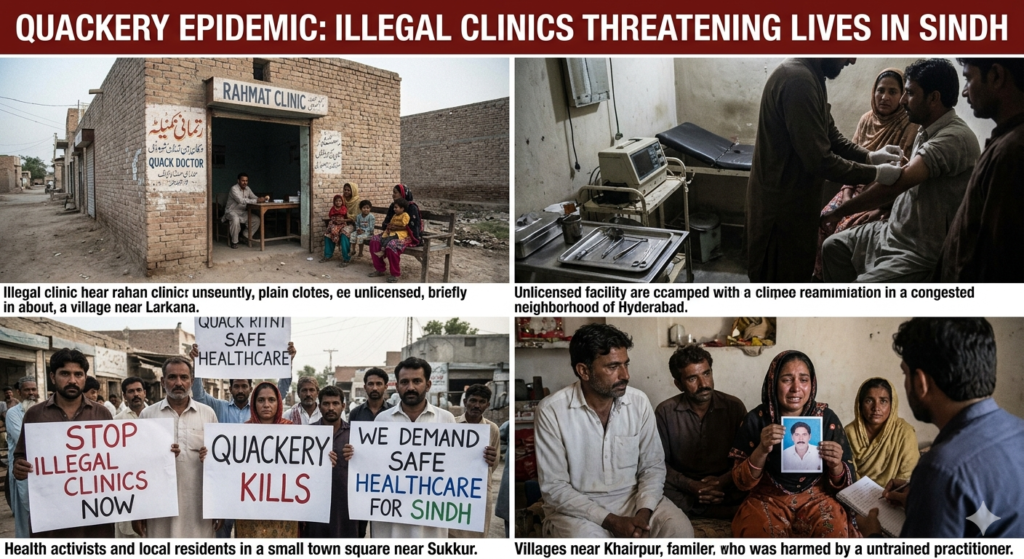
In a small village on the outskirts of Hyderabad, dozens of patients line up every evening outside a roadside shop. Inside, a man in a white coat takes their pulse, writes prescriptions, and gives injections charging just Rs300 (about $1) per visit.
His name is Abdul Waheed. He has no medical degree. No license. No formal training. During the day, he works as a hospital attendant. At night, he calls himself a doctor. “These patients have faith in me,” he told AFP journalists in January 2026. “No one has questioned me yet. If someone comes, I will see what to do.”
Abdul Waheed is not alone. He is one of an estimated 600,000 unqualified medical practitioners operating across Pakistan and thousands of them are running illegal clinics right now across Sindh.
What Is Quackery? A Clear Definition
Quackery refers to the fraudulent or ignorant practice of medicine by a person who has no recognized medical qualification, license, or training. In Pakistan, a “quack” is any person who:
- Diagnoses or treats patients without a valid medical degree
- Operates a clinic without registration from the Sindh Healthcare Commission (SHCC)
- Practices beyond their actual scope of training
- Uses a licensed doctor’s name or credentials on their signboard without their active supervision
Quacks are not just rural folk healers. Many dress in white coats, use medical equipment, and operate in fully furnished clinics. They are designed to look legitimate and that is precisely what makes them so dangerous.
The Scale of the Problem in Sindh
By the Numbers
The data paints a deeply alarming picture. A peer-reviewed cross-sectional study published in a medical journal conducted across all 29 districts of Sindh inspected 4,315 private practitioners. The findings were staggering:
| Metric | Finding |
| Total practitioners inspected | 4,315 |
| Unlicensed (quacks) found | 3,022 (70%) |
| Poor infection control observed | 89.4% of all providers |
| Reuse of syringes/IV drip sets | 78.7% of untrained providers |
| Licensed doctors renting their names to quacks | 155 confirmed cases |
| Estimated fake doctors nationwide | 600,000+ |
The Sindh Healthcare Commission (SHCC) has confirmed the 600,000 figure, based on estimates from the Pakistan Medical and Dental Council.
Where Are Quacks Most Concentrated?
The same study covering six divisions of Sindh found the highest concentrations of unlicensed practitioners in these areas:
- Shaheed Benazirabad Division — 739 unlicensed practitioners (24.5%)
- Hyderabad Division — 599 unlicensed practitioners (19.8%)
- Mirpur Khas — 510 unlicensed practitioners (16.9%)
- Sukkur — 484 unlicensed practitioners (16%)
- Larkana — 380 unlicensed practitioners (12.6%)
- Karachi — 310 unlicensed practitioners (10.3%)
Even Karachi, the country’s largest and most developed city, is not immune. Some reports suggest that up to 40% of all fake doctors in Pakistan operate in or around Karachi.
Why Do People Visit Quacks? The Real Reasons
Understanding why millions of patients choose unqualified practitioners is essential. It is not simply ignorance. The reasons are structural, economic, and cultural.
1. Cost
Quacks are cheap. At Rs300 per visit sometimes less they are accessible to daily-wage workers, domestic workers, and rural families who simply cannot afford a qualified doctor’s fees, which may be ten times higher.
2. Proximity
Public health centers in rural Sindh typically close between 1:00 and 2:00 PM. Quacks fill the void, operating in villages, small towns, and peri-urban neighborhoods where qualified doctors rarely set up practice.
3. Cultural Familiarity
Quacks often speak the local dialect, know the community, and have built years of trust. In contrast, qualified doctors in urban hospitals can feel distant, rushed, and unfamiliar.
4. No Wait Times
A quack will see you immediately. In the public health system, patients can wait for hours or days.
5. The Injection Preference
Many patients in rural Pakistan strongly prefer injections over oral medicines, believing injections work faster. Quacks happily oblige, administering drips and shots with little concern for sterility and often with reused syringes.
The Deadly Consequences: What Quackery Actually Does
The harm caused by quackery in Sindh is not abstract. It has a human face and it has killed and infected thousands of people.
The HIV Catastrophe in Larkana (2019)
The most devastating consequence of quackery in Sindh was the HIV outbreak in Ratodero, Larkana district, in 2019. In a matter of weeks, over 700 people were diagnosed with HIV — the majority of them children. A World Health Organization investigation team was dispatched to Pakistan.
Health officials directly linked the outbreak to quacks reusing contaminated syringes and IV drip sets. At least 17 quack doctors were arrested and more than 70 illegal clinics in Larkana were shut down following the outbreak.
The crisis did not end there. By late 2025, the HIV situation in Sindh had been described by health officials as “extremely alarming,” with nearly 4,000 HIV-positive children documented in the province.
The Sindh Healthcare Commission took immediate action following fresh HIV cases at Kulsoom Bai Valika Hospital in Karachi’s Keamari district in late 2025, launching a district-wide crackdown and filing FIRs against violators.
What Quacks Do That Qualified Doctors Would Never Do
Abdul Ghafoor Shoro, Secretary General of the Pakistan Medical Association, was direct in his assessment:
- Quacks do not know the side effects or correct dosages of medicines
- Their instruments are not sterilized they wash them with water
- They routinely reuse syringes, spreading hepatitis B, hepatitis C, and HIV
- Misdiagnosis is common, allowing serious diseases to worsen untreated
- When something goes wrong, families are left with catastrophic hospital bills
Beyond infection, quacks commonly prescribe incorrect antibiotics (fuelling antibiotic resistance), administer steroids recklessly, and delay patients from reaching qualified care until a condition becomes critical.
The “Ghost Doctor” Scandal: Licensed Names on Unlicensed Clinics
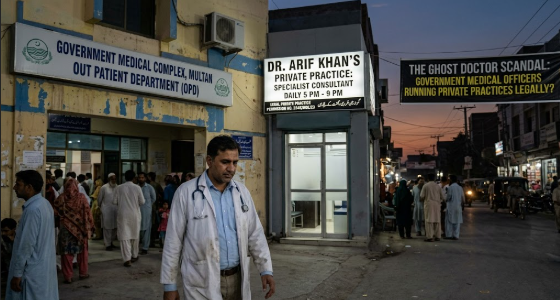
One of the most troubling findings from the 2020 SHCC study was the discovery that 155 MBBS doctors had rented out their names and credentials to be displayed as signboards outside quack-run clinics.
This practice sometimes called the “ghost doctor” problem gives illegal clinics a veneer of legitimacy. Patients believe they are visiting a qualified doctor’s clinic. In reality, the licensed doctor may never set foot inside.
The Sindh High Court has specifically addressed this issue. The SHCC’s legal mandate allows it to impose fines not only on the quack but also on the licensed doctor under whose name the quack was operating.
The Legal Framework: What the Law Says
The Sindh Healthcare Commission Act 2013
The Sindh Assembly ratified the SHCC Act in 2013 (notified March 2014). It covers the entire province and gives the SHCC sweeping powers:
- Register, classify, and inspect all private healthcare establishments
- Seal premises of unregistered or non-compliant operators
- Impose fines on unlicensed practitioners
- Coordinate with law enforcement to file criminal cases (FIRs)
Proposed Amendments: Imprisonment for Quacks
In September 2024, SHCC CEO Dr. Ahson Qavi Siddiqi announced a landmark proposal: amendments to the Sindh Healthcare Act that would, for the first time in Sindh’s history, allow quacks to face a minimum of three years’ imprisonment.
Under the proposal, separate courts would be established to handle healthcare violations, and a dedicated enforcement force would be created. Currently, quacks face only fines a penalty that many simply absorb as a cost of doing business.
What Criminal Law Already Provides
Under existing Pakistani law, practicing medicine without a license can already attract:
- Imprisonment of up to 3 years or more in cases where negligence led to death or permanent harm
- Heavy monetary fines from courts or regulatory bodies
- Sealing of premises
The Sindh Healthcare Commission: Successes and Failures
What SHCC Has Achieved
The SHCC’s Anti-Quackery Directorate established under the SHCC Act 2013 has achieved measurable results, especially in recent years.
2025 Annual Performance (January–December):
- Anti-quackery drives conducted: 3,251
- Quackery outlets sealed: 2,114
- Outlets resealed after regulation compliance failure: 527
- Total outlets sealed since inception: 1,587 (net, after compliance)
- Awareness sessions held in Hyderabad, Mirpurkhas, Shaheed Benazirabad, and Sukkur
- FIRs filed in HIV-affected areas of Karachi and SBA division
In 2022 alone, the SHCC’s Anti-Quackery teams conducted 2,564 inspection visits in a single quarter, sealed 768 establishments, and issued 813 warnings a 47% growth in enforcement momentum.
Where the System Is Failing
Despite these numbers, the SHCC has faced serious criticism.
The Hyderabad problem: A 2024 report by The Express Tribune described the SHCC as “faltering in its responsibilities,” noting that numerous fake doctors continued to operate clinics and private hospitals in the outskirts of Hyderabad unchecked.
Illegal de-sealing: A recurring problem is that sealed quack clinics are illegally re-opened shortly after SHCC teams leave. In the HIV crackdown meetings in Keamari, this issue was specifically flagged quacks or their associates were breaking seals and resuming operations.
Funding and staffing: The SHCC’s Anti-Quackery Directorate covers all 29 districts of Sindh with limited personnel and resources.
Political interference: Enforcement actions are sometimes reversed through political pressure, particularly in areas where quacks are well-connected to local political figures.
How to Verify a Doctor’s License in Sindh
Before seeing any private healthcare provider in Sindh, you can take these steps to verify their credentials.
Step 1: Check the PMDC Register
The Pakistan Medical and Dental Council (PMDC) maintains a register of all licensed doctors and dentists in Pakistan. Visit pmdc.gov.pk and search for the doctor’s name or registration number.
Step 2: Contact the SHCC
The SHCC maintains a register of all legally operating healthcare establishments in Sindh. You can:
- Call the SHCC helpline: 0800-07422 (free of charge)
- Email: info@shcc.org.pk
- Visit the SHCC website at shcc.org.pk
Step 3: Check the Physical Clinic
A legitimate, registered clinic must display:
- A valid SHCC registration certificate (visible to patients)
- The practitioner’s original PMDC registration certificate
- Degree certificates on the wall
If these are absent, or if the framed certificates look photocopied or unofficial, this is a red flag.
Step 4: Report Suspicious Clinics
If you suspect a clinic is operating illegally, you can:
- Call the SHCC helpline: 0800-07422
- File a written complaint with the SHCC, providing the clinic’s name, address, and any available evidence
Red Flags: Signs You May Be Seeing a Quack
Not every fake doctor is easy to spot. Here are key warning signs:
- The clinic has no visible SHCC registration certificate
- The doctor cannot show you their original PMDC registration number
- The doctor pushes injections or IV drips for common ailments like colds or fever
- Syringes are visibly reused or unwrapped from non-sterile packaging
- The clinic operates in very poor, unclean conditions with no basic hygiene protocols
- The “doctor” learned medicine by working as a compounder, ward boy, or hospital attendant
- The consultation fee is unusually low (Rs100–Rs500 for complex issues)
- The practitioner is aggressive about administering medicines immediately without proper examination
What Sindh Needs: A Road Map for Reform
Experts and public health advocates agree on what structural changes are urgently needed.
1. Criminal Penalties Must Be Enacted
The proposed amendments to the SHCC Act must be passed without delay. Fines alone do not deter repeat offenders. Three-year minimum sentences would.
2. Expand the Anti-Quackery Directorate
The SHCC needs significantly more field staff, transport, and budget to cover 29 districts. Current enforcement is reactive and stretched thin.
3. Fix the Public Healthcare Gap
Quacks thrive because the public health system fails rural communities. Primary health centers that close at 1 PM leave patients with no legitimate alternative. Extended hours and mobile health units can reduce demand for quack services.
4. Community Awareness Campaigns
Many patients simply do not know the difference between a qualified doctor and a quack, or the risks involved. Mass media campaigns in local languages Sindhi and Urdu can shift behavior.
5. Prosecute “Ghost Doctors”
Licensed doctors who rent their names to quacks must face professional consequences, including suspension of their PMDC license. The SHCC should pursue these cases aggressively.
6. Create Accessible Reporting Mechanisms
The SHCC’s plan to introduce an online reporting system with geo-tagging for quack clinics is a step forward. Similar systems in Punjab where citizens can scan QR codes to report illegal establishments should be adopted in Sindh.
Frequently Asked Questions (FAQ)
What is a quack doctor?
A quack doctor is a person who practices medicine without a valid medical degree or license. In Pakistan, this typically means someone who has not completed an MBBS or equivalent degree recognized by the Pakistan Medical and Dental Council (PMDC), yet diagnoses illnesses, prescribes medicines, and performs procedures on patients.
How many fake doctors are operating in Sindh?
Based on a cross-sectional study conducted by the SHCC’s Anti-Quackery Directorate across 29 districts of Sindh, 70% of private practitioners inspected were found to be unlicensed. Nationwide, the Pakistan Medical Association and PMDC estimate there are over 600,000 fake doctors in Pakistan.
Is quackery illegal in Pakistan?
Yes. Practicing medicine without a license is illegal under the Sindh Healthcare Commission Act 2013 and Pakistani criminal law. Penalties include fines, sealing of premises, and imprisonment of up to 3 years in cases of harm or death. Proposed new amendments to the SHCC Act would make imprisonment mandatory for quacks in Sindh.
What diseases have been linked to quacks in Sindh?
The most documented outbreak was the HIV epidemic in Larkana’s Ratodero area in 2019, directly linked to quacks reusing contaminated syringes. Quacks in Sindh are also linked to the spread of hepatitis B and hepatitis C through unsafe injection practices. Antibiotic resistance and delayed treatment of serious diseases (tuberculosis, cancer, cardiac conditions) are additional documented consequences.
How do I report a quack clinic in Sindh?
Call the Sindh Healthcare Commission’s free helpline at 0800-07422, or email info@shcc.org.pk. You can also file a formal complaint in writing, describing the clinic’s location, the practitioner’s name if known, and any evidence. The SHCC is legally required to investigate and take enforcement action.
How can I check if a doctor in Sindh is licensed?
Search the Pakistan Medical and Dental Council’s (PMDC) online register at pmdc.gov.pk. You can also contact the SHCC directly. A legitimate doctor must also display their original PMDC registration certificate in their clinic.
Why do poor communities continue to visit quacks despite the risks?
The primary reasons are cost, proximity, and cultural familiarity. Qualified healthcare in Pakistan is expensive and often located far from rural communities. Public health centers close in the early afternoon. Quacks fill this gap at low cost, often speaking local dialects and having built personal trust over years. Addressing quackery permanently requires fixing these underlying gaps in the public health system.
Can a quack be held criminally responsible if a patient dies?
Yes. Under Pakistani law, if an unqualified practitioner’s negligence results in death or permanent harm, they can face criminal prosecution and imprisonment of three years or more. Families of victims can also file civil suits for compensation. However, legal enforcement has historically been weak, which is why new legislation is being pursued.
Key Takeaways
- An estimated 70% of private practitioners inspected in Sindh were found to be unlicensed
- 600,000+ fake doctors operate across Pakistan, with thousands in Sindh alone
- Quacks reuse syringes and IV sets at alarming rates, directly causing HIV and hepatitis outbreaks
- The 2019 Larkana HIV outbreak affecting hundreds of children is the most tragic documented consequence of quackery in Sindh
- The SHCC sealed over 2,114 quack outlets in 2025, but illegal re-openings remain a persistent problem
- Proposed legislative changes would impose minimum 3-year prison sentences for quacks a historic first for Sindh
- You can verify any doctor’s credentials by calling the SHCC helpline at 0800-07422 or checking the PMDC register
What You Can Do Right Now
Quackery persists because it is tolerated by patients who do not know the risks, by communities who do not report illegal clinics, and by systems that do not enforce the law effectively.
You can change that.
If you live in Sindh:
- Check every healthcare provider’s credentials before a consultation
- Share the SHCC helpline number (0800-07422) in your community
- Report any suspected quack clinic your report can save lives
If you work in health policy or journalism:
- Push for the fast passage of the SHCC Act amendments that would imprison quacks
- Advocate for extended public health center hours in rural Sindh
- Investigate and report the “ghost doctor” scandal licensed doctors renting their credentials to quacks
Quackery in Sindh is not a relic of the past. It is an active, daily public health crisis. Every sealed clinic is a life potentially saved. Every patient who learns to verify their doctor’s credentials is protected. The epidemic can be stopped. But it requires action from regulators, from communities, and from citizens like you.