
Ten years ago, most doctors would have told you type 2 diabetes is a one-way street. Once diagnosed, you manage it you don’t undo it.A landmark UK trial called DiRECT found that <cite index=”10-1″>46% of participants achieved remission of type 2 diabetes within one year</cite> of an intensive weight-management program.
Among those who lost significant weight, remission rates climbed even higher. This wasn’t a fringe study it was a rigorous, randomized controlled trial published in one of medicine’s top journals.
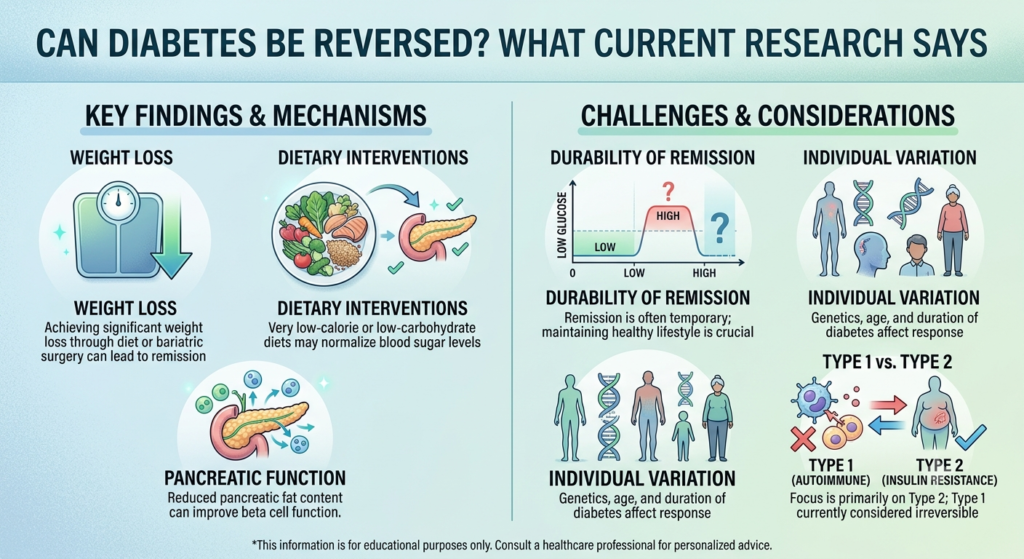
So can diabetes actually be reversed? The honest, evidence-based answer is: yes, for many people with type 2 diabetes, but with important caveats and no, not for type 1 diabetes. Below, we break down exactly what the research shows, who it applies to, and what “reversal” really means in medical terms.
Key Takeaways
- Type 2 diabetes remission is real and documented in multiple randomized controlled trials, not just anecdotes.
- “Reversal” and “cure” are not the same thing. Doctors prefer the term “remission” because the underlying risk doesn’t fully disappear.
- Weight loss is the biggest lever. Losing 10–15 kg (roughly 22–33 lbs) is linked to the highest remission rates in clinical studies.
- Type 1 diabetes cannot currently be reversed — it’s an autoimmune condition, not a lifestyle-driven one.
- Remission can fade over time, especially if weight is regained, so ongoing monitoring matters even after success.
What Does “Reversing Diabetes” Actually Mean?
Before diving into the research, it’s worth clearing up a common point of confusion. Medical organizations don’t use the word “reversed” the way headlines do.
In 2021, the American Diabetes Association (ADA), along with several international diabetes groups, published a consensus statement to standardize the terminology. They defined remission as: <cite index=”18-1″>a return of HbA1c to less than 6.5% that occurs spontaneously or following an intervention and that persists for at least three months in the absence of usual glucose-lowering pharmacotherapy</cite>.
Here’s how the key terms differ:
| Term | What It Means | Used By Doctors? |
|---|---|---|
| Cure | Condition permanently gone, no relapse risk | Rarely — <cite index=”22-1″>experts agree this term should be avoided for type 2 diabetes</cite> |
| Remission | Blood sugar in normal range without medication, for 3+ months | Yes — this is the preferred clinical term |
| Reversal | Blood sugar drops below the diabetes threshold | <cite index=”22-1″>Used informally to describe the process, but experts say it shouldn’t be equated with remission</cite> |
| Management | Blood sugar controlled, often with medication | Standard ongoing care |
Why does this distinction matter? Because even in remission, the underlying biology that caused diabetes — insulin resistance, reduced beta-cell function — hasn’t necessarily vanished. As one Yale researcher puts it plainly: <cite index=”3-1″>”If you reverse insulin resistance, you reverse type 2 diabetes.”</cite> But that insulin resistance can come back if the habits that improved it don’t stick.
Type 1 vs. Type 2 Diabetes: Why This Matters for Reversal
Not all diabetes is created equal, and this is the single most important distinction to understand before reading further.
Type 1 Diabetes
Type 1 is an autoimmune condition. The immune system destroys the insulin-producing beta cells in the pancreas. There is currently no lifestyle intervention, diet, or supplement that regenerates these cells or stops the autoimmune process. People with type 1 diabetes require insulin for life. Research into beta-cell transplants and immunotherapies is ongoing, but this remains experimental and is not a form of “reversal” available today.
Type 2 Diabetes
Type 2 accounts for <cite index=”1-1″>90 to 95 percent of diabetes cases</cite> and is driven primarily by insulin resistance — the body’s cells stop responding properly to insulin. This is where the term “reversal” actually applies, because insulin resistance is closely tied to modifiable factors: excess body fat (especially around the liver and pancreas), physical inactivity, and diet.
Prediabetes
Prediabetes — elevated blood sugar that hasn’t yet crossed the diabetes threshold — is the easiest stage to reverse. Research on the Diabetes Prevention Program found that <cite index=”26-1″>combining a 7% body weight loss with lifestyle changes reduced the relative risk of progressing to type 2 diabetes by 76% over six years</cite>.
What the Research Actually Shows
The DiRECT Trial: The Gold Standard
DiRECT (Diabetes Remission Clinical Trial) is the most frequently cited study on this topic, and for good reason — it was a large, randomized, controlled trial run in real-world primary care clinics, not a specialty research lab.
The protocol: <cite index=”11-1″>participants had antidiabetic and antihypertensive drugs withdrawn, followed a very low-calorie total diet replacement (825–853 kcal/day) for 12–20 weeks, then gradually reintroduced food</cite> alongside long-term structured support.
The results were striking:
- At 1 year: <cite index=”10-1″>46% of intervention participants achieved remission</cite>, compared with just a few percent in the control group.
- At 2 years: <cite index=”9-1″>36% of participants remained in remission</cite>, with an average weight loss of 7.6 kg.
- Weight loss mattered enormously: <cite index=”13-1″>86% of participants who lost 15 kg or more were in remission, compared to none of those who gained weight</cite>.
- At 5 years: <cite index=”9-1″>the remission rate dropped to 13% of those with follow-up data</cite> — still meaningfully higher than typical care, but a reminder that maintenance is hard.
The Bottom Line on Weight Loss
Across multiple studies, one pattern holds: the more weight lost, the higher the odds of remission. The DiRECT data broke this down clearly:
| Weight Loss | Remission Rate |
|---|---|
| Weight gained | 0% |
| 0–5 kg lost | <cite index=”13-1″>7%</cite> |
| 5–10 kg lost | <cite index=”13-1″>34%</cite> |
| 10–15 kg lost | <cite index=”13-1″>57%</cite> |
| 15 kg or more lost | <cite index=”13-1″>86%</cite> |
Source: DiRECT trial, published in The Lancet.
Bariatric Surgery: The Most Powerful Intervention
For people with more advanced obesity, bariatric surgery produces the highest remission rates of any current treatment. A widely cited meta-analysis found <cite index=”30-1″>an overall complete diabetes remission rate of 78.1% after bariatric surgery</cite>, with rates varying by procedure type.
More recent, stricter-criteria studies show more modest but still substantial numbers: one large study found <cite index=”28-1″>57% of participants achieved remission after gastric bypass, versus 22% after lap-band surgery</cite>. Another cohort using contemporary procedures found <cite index=”33-1″>around 80% of patients were still in remission one to three years after surgery</cite>.
Surgery isn’t without trade-offs — it carries surgical risk, requires lifelong nutritional monitoring, and isn’t appropriate for everyone. But for people with severe obesity and type 2 diabetes, it currently offers the strongest evidence for durable remission.
What About Medications Like GLP-1 Agonists?
Newer weight-loss medications — GLP-1 receptor agonists such as semaglutide (Ozempic, Wegovy) and tirzepatide (Mounjaro, Zepbound) — have generated enormous interest. These drugs work by <cite index=”6-1″>mimicking a natural hormone that reduces hunger, but unlike the body’s own version, they remain active for up to a week</cite>, leading to substantial weight loss for many users.
Because weight loss is the primary driver of remission, these medications can indirectly support diabetes reversal in the same way surgery or diet-based weight loss can. However, most current data on remission specifically (versus blood sugar control) comes from lifestyle and surgical studies. Long-term remission data for GLP-1 drugs is still accumulating, and blood sugar often rises again if the medication is stopped without other changes.
Who Is Most Likely to Achieve Remission?
Research points to several factors that improve the odds:
- Shorter diabetes duration. People diagnosed less than 4–6 years ago respond better than those with long-standing disease, likely because beta-cell function is better preserved early on.
- Younger age. <cite index=”21-1″>Younger adults, ages 18 to 29, had higher odds of remission compared to adults ages 75 or older</cite>.
- Greater weight loss. As shown above, this is the strongest single predictor.
- Not using insulin. People who haven’t progressed to insulin therapy tend to have more preserved pancreatic function.
- Lower baseline HbA1c. Starting with less severe blood sugar elevation makes the goal more reachable.
This doesn’t mean remission is impossible for people who don’t fit this profile — it means the odds are better for some than others, and expectations should be realistic.
Practical Steps Supported by Research
If you have type 2 diabetes or prediabetes and want to pursue remission, here’s what the evidence actually supports:
1. Prioritize Meaningful Weight Loss
Aim for a structured, sustainable weight-loss plan rather than a crash diet. The DiRECT trial used a supervised very-low-calorie total diet replacement, but this should be done under medical supervision — it’s not a DIY approach, especially for people on diabetes or blood pressure medication.
2. Focus on Food Quality, Not Just Calories
UCLA researchers advise a simple heuristic: <cite index=”6-1″>eat foods as close to their natural state as possible — whole apples instead of apple juice, brown rice instead of bleached white rice</cite>. Diets emphasizing vegetables, lean proteins, whole grains, and healthy fats (like the Mediterranean diet) are consistently linked to better metabolic outcomes.
3. Build Consistent Physical Activity
Exercise improves insulin sensitivity independently of weight loss. Combining resistance training with regular cardiovascular activity tends to produce the best glycemic improvements.
4. Discuss Medication Options With Your Doctor
Metformin, SGLT2 inhibitors, and GLP-1 receptor agonists each have different roles. Some can support weight loss and remission; others primarily manage blood sugar without necessarily leading to remission. This is a conversation for your care team, not a self-directed decision.
5. Consider Bariatric Surgery If Eligible
For people with a BMI in the severe obesity range and type 2 diabetes, surgical evaluation is worth discussing, given its strong remission data.
6. Keep Monitoring Even After Remission
Since remission can fade, especially with weight regain, the ADA consensus recommends ongoing HbA1c testing and screening for diabetes-related complications even after medications are stopped.
Can Diabetes Come Back After Remission?
Yes. This is one of the most important — and most often glossed-over — parts of the story. Remission is not permanent by default. Weight regain is the most common reason blood sugar rises again. In the DiRECT trial, remission rates fell from 46% at one year to 36% at two years and 13% at five years, largely tracking with how well participants maintained their weight loss.
This is why doctors avoid the word “cure.” Remission requires ongoing maintenance, much like remission from other chronic conditions.
Frequently Asked Questions
Can type 2 diabetes really be reversed permanently?
Not permanently in the way a cure implies. Type 2 diabetes can go into remission — normal blood sugar without medication — for months or years, but the underlying tendency toward insulin resistance can return, especially with weight regain. Ongoing healthy habits and monitoring are needed to sustain it.
How much weight loss is needed to reverse type 2 diabetes?
Clinical trial data suggests a clear dose-response relationship. Losing 15 kg (about 33 lbs) or more was linked to an 86% remission rate in the DiRECT trial, compared to 34% for those who lost 5–10 kg. Even modest weight loss improves blood sugar control.
Can type 1 diabetes be reversed?
No. Type 1 diabetes is an autoimmune condition that destroys insulin-producing cells. There is currently no proven method to reverse this process outside of experimental treatments still in clinical trials. People with type 1 diabetes require lifelong insulin.
What is the difference between diabetes remission and diabetes reversal?
“Remission” is the clinically defined term: HbA1c below 6.5% for at least three months without diabetes medication. “Reversal” is often used informally to describe the same process, but medical experts caution against treating the two as identical, since remission implies ongoing monitoring rather than a permanent state.
Can diet alone reverse diabetes without medication?
For some people, yes — particularly those with a shorter diabetes duration and significant weight loss achieved through diet. The DiRECT trial demonstrated this using a structured, medically supervised low-calorie diet. However, results vary by individual, and any major dietary change should be discussed with a healthcare provider, especially if you’re on medication.
Is intermittent fasting effective for reversing diabetes?
Some studies suggest intermittent fasting can improve insulin sensitivity and support weight loss, which are both linked to remission. However, robust long-term randomized trial data specifically on remission (as opposed to blood sugar improvement) is still more limited than for total diet replacement or bariatric surgery approaches.
Does bariatric surgery guarantee diabetes remission?
No, but it offers the highest remission rates currently documented, with some studies showing rates as high as approximately 80% in the first few years after modern procedures like gastric bypass and sleeve gastrectomy. Remission rates vary by surgery type, and rates decline somewhat over longer follow-up periods.
How long does it take to reverse type 2 diabetes?
In the DiRECT trial, participants saw remission as early as 12 months after starting the intervention. Timeframes vary based on starting weight, diabetes duration, and how aggressively lifestyle changes are implemented.
The Bottom Line
Diabetes reversal isn’t hype — it’s backed by randomized controlled trials, tracked over years, published in respected medical journals. For many people with type 2 diabetes, especially those diagnosed recently and able to achieve substantial weight loss, remission is a realistic goal.
But it comes with honest caveats: type 1 diabetes cannot currently be reversed, remission requires sustained effort to maintain, and results vary from person to person based on age, disease duration, and how much weight is lost.
If you’re living with type 2 diabetes or prediabetes, the most useful next step is a conversation with your doctor about whether a structured weight-management program, medication adjustment, or surgical evaluation makes sense for your specific situation. The research shows remission is possible — but it works best as a partnership between you and your care team, not a solo experiment.